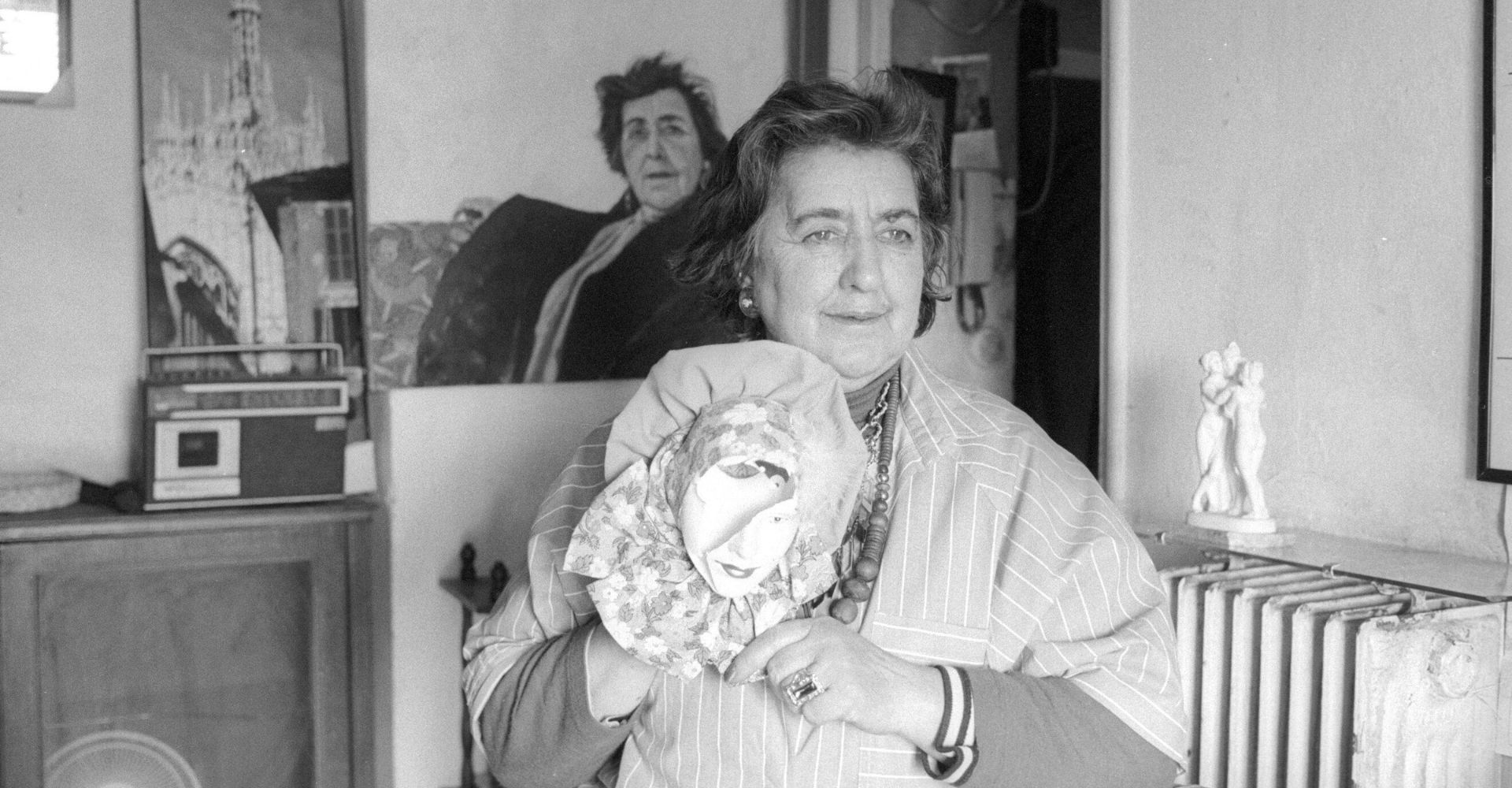
A dwelling encloses within it not only the personal objects of those who live there. It is also a physical representation of a space that goes beyond material boundaries, a representation of personality, of passions and, why not, of the physical and psychological conditions of those who inhabit it.
And this is even more valid when we talk about inhabitants whose inner world becomes words on the page—in rhymes and in prose, in stories and novels. Visiting the dwellings of writers allows us, therefore, to know that inner world a little better and offers us the possibility to imagine them physically seated at that desk, giving life to that novel, that collection of poems…
A tour of literary Italy
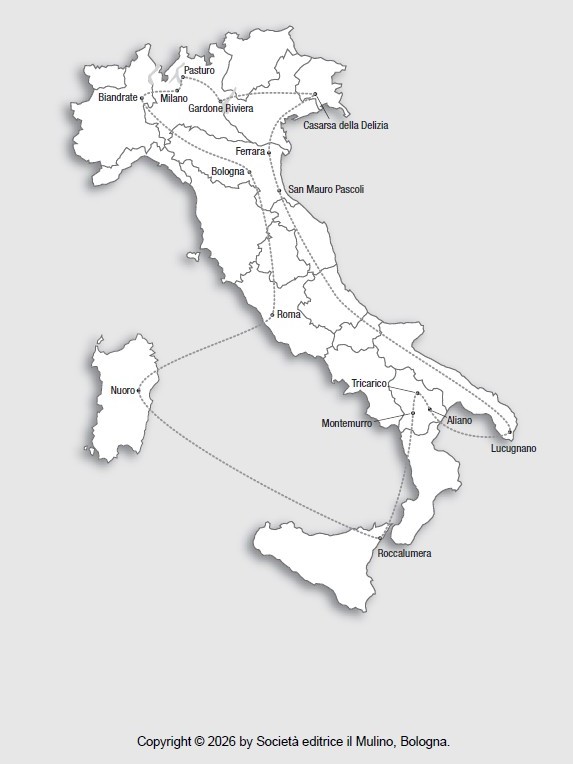
They know this well, Emilio Fabio Torsello, a journalist and documentarian, and Mara Sabia, a teacher of literary subjects, who together sign Andare per dimore letterarie, a saggio-reportage published by Il Mulino. The two authors, who founded in 2013 La Setta dei poeti estinti (a literary project that spreads culture and poetry through social media and live events), compose a literary itinerary that explores, from the islands to the north, several house-museums of great names of the 20th century, not only with the aim of “restoring an atmosphere to objects but to reweave that fabric of relationship that binds a writer to a place.”

Starting from the islands and the dwellings of authors such as Grazia Deledda and Salvatore Quasimodo (and his literary park), the journey then moves south, with the “esoteric” Salento of Palazzo Comi and the Basilicata of Leonardo Sinisgalli (but not only).
Then the focus shifts to the city of Rome, among Elsa’s Rooms and the Italo Calvino Room (not to forget Alberto Moravia and Casa Bellonci, but one could keep going…).
Next comes the nest of the poet of the “fanciullino”, Ferrara, which collects traces of Giorgio Bassani, Casa Colussi, a meeting place of the summers of young Pasolini (to name just a few itinerary highlights), up to Lombardy, first in Pasturo, along the paths of Antonia Pozzi, and finally Milan, at the home of Alda Merini.
At each stop there is a sense of a “literary continuum” that, as the book’s preface notes, “seems never to have paused”: within the various dwellings, there are indeed references and echoes of other great figures of literature—from the desk and university study of Giosuè Carducci, kept in the birthplace of Giovanni Pascoli, to the Giorgio Bassani Foundation (where his study is reconstructed and his documents are preserved), housed in Casa Ariosto, in Ferrara.
«The House of Poetry Will Never Have Doors», Alda Merini, Milan and the Wall of Angels
No, there are shadows inside here.
There is the harmony in the fact that I fill it, but as soon as
I leave this house freezes and when I return I feel
the cold of this emptiness. Because perhaps I am only
the harmony of this house.
I am the one who gives life to these objects, essentially inanimate.
Thus Alda Merini describes to Paolo Taggi her house on the Naviglio Milanese, just forty-five square meters at 47 Ripa di Porta Ticinese, from which she would repeatedly risk eviction, a place—or perhaps one should say “non-place”—composed of a babel of knickknacks, toys, cigarette butts, bottles, bottle caps fallen and never picked up from the floor, photos and posters collected over a lifetime and with the inseparable piano.
Her house was deeply loved but also feared, especially in the eighties, a period when the poet felt persecuted, obsessed with the dark figure of the porter of the building where she lived: “the porter” or also “the custodian” recurs in several of her prose works, including Delirio amoroso, the autobiography Reato di vita, but also Il tormento delle figure and La nera novella. The porter is always a real, grim character, described as a horrible killer and torturer, yet at the same time he becomes a great metaphor for the terror and surveillance experienced in the psychiatric hospital, as Merini writes in Pazza della porta accanto: “The custodian is a man as closed as my jaws have been closed by someone’s bite. The custodian is the madhouse, it is electroshock.”
A house symbolic of a dramatic past, such as the twenty years Merini would spend between discharges and hospitalizations at Paolo Pini in Milan, but also a treasury of verses that would lead to her rebirth when, like a phoenix, as the philologist Maria Corti called her, she would find in the poetry that had accompanied her since childhood a lifeline to return to living and to rework the incandescent material of the asylum experience into that masterwork poem La Terra Santa, first published by Scheiwiller in 1984 and followed by other extraordinary collections of verse, even amid a storm of periods characterized by alternating vicissitudes and financial constraints.
The house on the Naviglio Milanese was, throughout the poet’s life, a true harbor for the many who stayed there: friends and colleagues, but also poor painters, homeless people, those Merini gave shelter to in exchange for little money or simply for companionship, especially in the years when, having been definitively discharged from the asylum and with her husband Ettore long since dead after a painful illness, she was left alone to lead a precarious life and lived on the help of friends and what she could earn by selling her poems to passersby and to the patrons of Chimera, a bar-cum-bookstore in Porta Genova, frequented by writers such as Aldo Busi, Vincenzo Consolo, Pier Vittorio Tondelli, Paolo Volponi and her son Roberto, a place rich in literature, open late, that no longer exists. Merini was a constant presence with her typewriter: she is remembered tapping the texts directly onto carbon paper because the ink ribbon had run out long ago. She sold her poems for a thousand lire each.
She would write that her presence at the Chimera bar was a “special reclaiming,” a place where “hope could be found again.” The definitive turning point in Merini’s literary career came, then, thanks to Paolo Di Stefano who oversaw the 1991 edition of the collection Vuoto d’amore, in the famous white poetry series of Einaudi, an important volume that brings together unpublished pieces selected by Maria Corti and reissues La Terra Santa, long unobtainable for years. The true heart of Merini’s house, however, is the wall above the bed: completely covered with phrases, names, drawings and telephone numbers, mostly written with red lipstick: the poet called it “the Wall of Angels,” perhaps because it is a kind of bizarre address book that allowed her to keep track of the people she loved.
With pride she kept the old piano, which, with a nearly mystical fervor, would play for her throughout her life: there are many photos of Merini seated at the piano and numerous direct testimonies from those who knew her, such as the poet Elio Pecora, who recalls the calls in which Alda Merini spoke to him while playing.
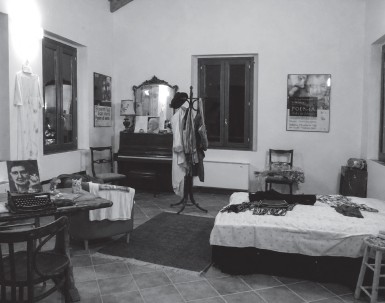
Today the Wall of Angels, detached and restored, the old Bentley piano, the Invicta typewriter, the poet’s bed, the apartment door and some trinkets, such as the indispensable lipstick, some necklaces, a yellow plastic figurine, a Coca‑Cola can, numerous lighters and the Diana cigarettes she smoked steadfastly until the last days of her life in hospital, an old rug and a coat rack are preserved and on display not inside the walls of the apartment at 47 Ripa di Porta Ticinese, but in a nearby building, in what used to be a tobacco shop and today is the Piccolo museo spazio Alda Merini at 30 Magolfa.
Those who want to see with their own eyes what remains of Merini’s dwelling must go to the reconstructed Alda Room in this multifunctional space where one can also attend performances, concerts and take part in guided verse readings organized by volunteers.
In the outer garden there is a large papier-mâché sculpture representing the poet’s face, a gift from the Viareggio Carnival. And if you want to reread Alda’s poems while sipping a coffee, as she did at Porta Genova’s coffee shop, there is also a small bar.
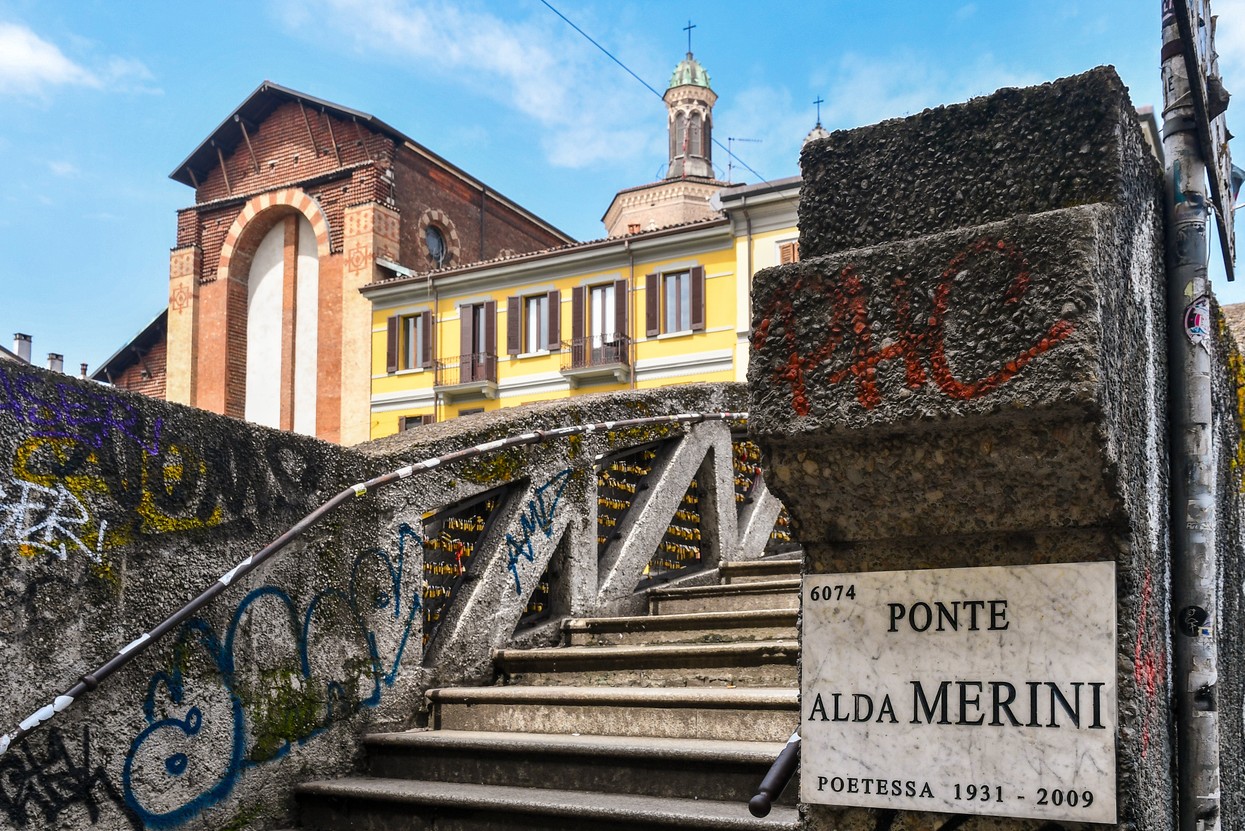
But if, instead, you would really like to meet Alda, the advice is to go to the Naviglio, right opposite the doorway of the apartment where the poet lived and on which today hangs a plaque that reads “To Alda Merini in the intimacy of the mysteries of the world” with the birth and death dates, 21/03/1931-1/11/2009: you will find a small bridge named after her in 2019. The spirit of the Navigli’s poet is along the water, in the neighborhood where she spent her life, in Milan—not for its nightlife, as this area is today dotted with bars, but for the true city she loved with visceral passion, never abandoning it, except for the few years she lived in Taranto with poet Michele Pierri, her second husband, the mother-Milan that rose again after the bombings of World War II, which saw her as a girl barely sixteen stepping into the literary salon of critic Giacinto Spagnoletti, into the song of the laundrywomen, the multifaceted and comforting city that often appears in her verses
Milan with its dizzying thoughts
where a thousand joys
die weeping along the Naviglio
Copyright © 2026 by Il Mulino, Bologna.
(continues in bookstores…)