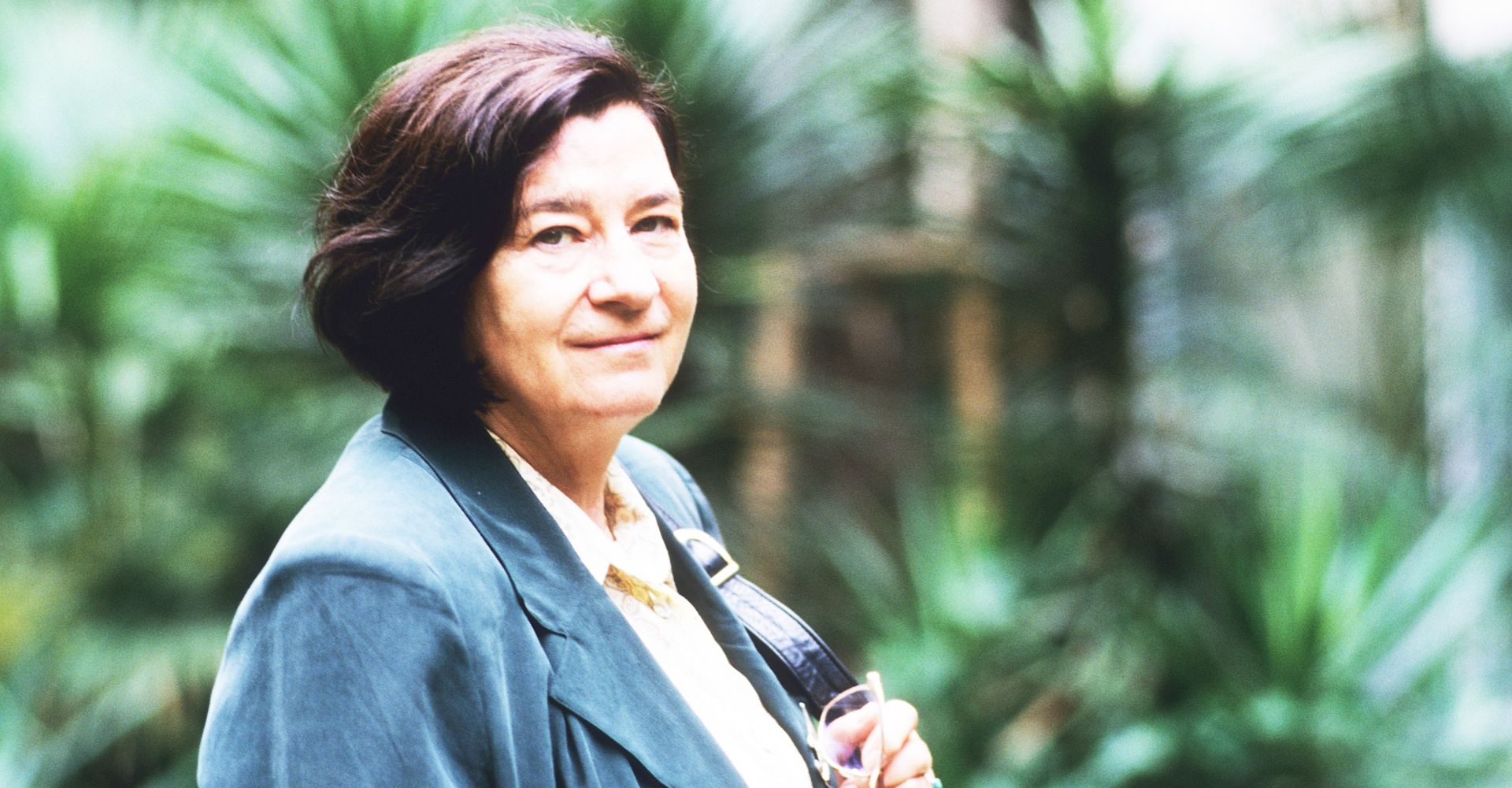
“She had always feared uprooting. She was torn between the desire for escape and the fear of not being able to express herself fully in a different place: without her own language, her own places, her own memories, what would happen?”
In a recent interview given to Repubblica, Christa Wolf (1929-2011) was sketched in this way by her longtime Italian translator—and close friend—Anita Raja, who managed to condense into a few strokes an intense and controversial life, closely involved in many pivotal events of World War II and the Cold War…
(Re)discover Christa Wolf through her books
The past is not dead; it is not even past. We detach ourselves from it and act as if it were foreign.
(from Childhood Plot)
Born in 1929 in Landsberg an der Warthe (today Gorzów Wielkopolski, in Poland), into a diligent family of German merchants, the writer grows up amidst the rise of Nazi Germany: in 1939 she enters the League of German Girls, while in 1945, as the Red Army advances, she is forced to flee with her family to central Germany, leaving behind her home and the places of her childhood.
That constitutes the first experience of uprooting in her life—which, as Raja emphasizes, Christa Wolf would fear would recur at her doorstep for a long time to come.
In the postwar period she later joins the Socialist Unity Party of the newborn German Democratic Republic, with the aim of taking part in the building of a new society. In the same year she enrolls at the University of Jena, moving from pedagogical studies to German studies and history. There she also meets the writer Gerhard Wolf (1928-2023), who she marries in 1951 and with whom she will have two daughters.

She completed her studies in 1953 with a thesis on the author Hans Fallada (1893-1947), and a few years later made a trip to Moscow that would inspire her first substantial story, while she established early contacts with Central European cultural figures, including Heinrich Böll (1917-1985) and Max Frisch (1911-1991).
Life and writing, consequently, begin to travel on the same track for her, especially because she belonged to a generation of women who, after a solid Marxist education, had developed a civil sensibility rooted in feminism.
heir to Anna Seghers (1900-1983) and fascinated by the “wild” nature of Ingeborg Bachmann (1926-1973), Christa Wolf thus begins to focus on a chain of questions that will prove crucial in her output and in her personal choices.
What role should one assume in the society in which one operates in order to dismantle ancient injustices? How to exercise one’s dissent toward a ruling class in which trust has been lost? And with what means to preserve one’s freedom of expression without paying too high a price?
These issues are not easy to resolve, and they provide the leitmotiv for five Christa Wolf books recently or soon reissued by the Edizioni e/o (in view of the centenary of the author’s birth in 2029), each useful in its own way to reconstruct the evolution of her thinking.
From novels to pamphlets, including retellings of myth, we thus (re)discover, through some of her masterworks, an intellectual continually animated by the desire to feel part of the society in which she grew up, without relinquishing her own autonomy of judgment.
The Divided Sky (1963), Christa Wolf’s first success
Once, lovers, before parting, would seek a star to which their eyes could meet in the evening. What should we seek? – The sky, at least, cannot be divided, said Manfred wittily.
Let us begin by saying that Christa Wolf’s activity took off in 1956 when she took on the role of editor-in-chief at the Berlin publishing house Neues Leben, while between 1958 and 1959 she collaborated with the magazine Neue Deutsche Literatur; after moving to Halle, she continued as a editorial consultant at the Mitteldeutscher Verlag, where she remained until 1962.
Alongside these commitments, in March 1960 she spent a study period at the state facility for the construction of railway cars in Ammendorf, while coordinating a literary circle frequented by workers and aspiring writers.
The contact with the industrial reality and the routine of workers sparked in her new reflections, which soon flowed into her first substantial narrative work.
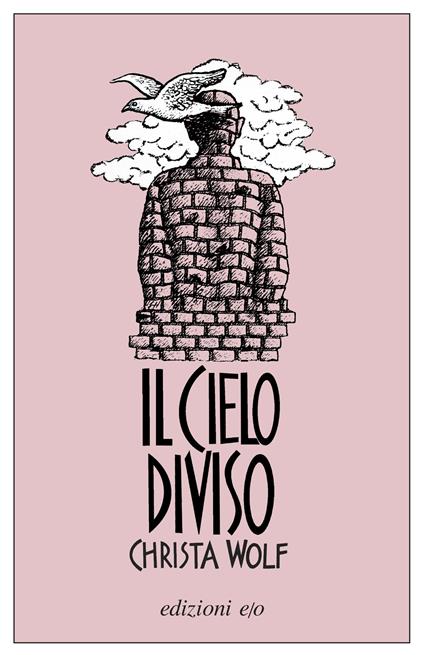
After her debut in 1961 with Moskauer Novelle and the start of an intense epistolary exchange with writer Brigitte Reimann (1933-1973), destined to continue until the latter’s death, the decisive turn came in 1963 with The Divided Sky (e/o, translation by Maria Teresa Mandalari), welcomed from the outset by the international critics.
Winner of the Heinrich Mann Prize and adapted to cinema the following year by Konrad Wolf (1925-1982), the novel—which Jinny Erpenbeck has recently drawn on for her Kairos (Sellerio, Ada Vigliani translator), which won the International Booker Prize in 2024—follows the love story between Rita and Manfred in East Germany.
Manfred, disappointed by the bureaucratic system and by the rejection of a research project, decides to flee to West Berlin. Rita goes to visit him to convince him to return, but she feels like a stranger in that consumerist environment and goes back to the East to honor the ideals she had joined, even though a few days after her return (and a serious accident she suffers at the factory) the Berlin Wall is erected…
An elegant and fluid text, in which the characteristics of subjective realism—for which Christa Wolf would later stand out—are already identifiable, and which has the merit of lucidly and empathetically presenting the division of Germany from the Soviet side, based on a lively formal experimentation and the use of temporal layers, returning to the individual consciousness a central role in understanding the dynamics of the collective.
Premises to Cassandra (1983)
Now there is no longer a need to be “Cassandra”: the majority begins to perceive what is coming. A malaise that frightens, which many register as emptiness, as a loss of meaning. In a new attribution of meaning by worn-out institutions—something many had grown used to—there is no hope. Zigzagging is required. But there is no escape route.
Success, however, brings with it not only prestige and recognition. In the sixties to seventies, Christa Wolf adopted a increasingly critical stance toward the DDR, opposing cultural censorship during the XI Plenum of the SED in 1965, and, in 1976, signing a call against the revocation of citizenship for Wolf Biermann, after the songwriter had criticized the government during a concert in Cologne.
Accused of high treason and subject to Stasi surveillance, she becomes increasingly distant from the regime, choosing to remain in the country to contribute to social change through teaching, study, and writing.
A pivotal moment in this context is the Grecia trip she undertakes with her husband in 1980, where she confronts a classical tradition she tries to reinterpret through the lens of its most stubborn contradictions and inequalities, in opposition to the Nazi interpretation of a supposed racial superiority of ancient civilizations.
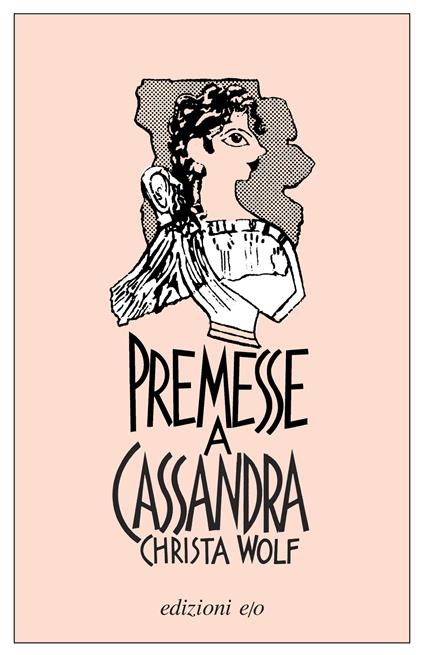
It is then that her obsessive interest in Cassandra explodes, which she recounts in four lectures given in 1982 at the University of Frankfurt—and later in the pamphlet Premises to Cassandra (e/o, Anita Raja translator), an ideal preface to a method and a poetics for her audacious rewriting of the myth of the unfortunate priestess.
The work dialogues with Homer (circa VIII-VII centuries BC) and Esquilo (circa 525-456 BC), with Friedrich von Schiller (1759-1805) and Johann Wolfgang von Goethe (1749-1832), with Bertolt Brecht (1898-1956) and the aforementioned Ingeborg Bachmann, turning language into an exercise in critical thinking, analytical and, above all, generative thought.
The portrait of Cassandra, in fact, far from being pre-defined in Christa Wolf’s mind, takes shape as the author (de)scribes its memory and key experiences, like a voice that gradually manages to rediscover itself.
Thus it is not surprising that the nature of Premises to Cassandra evolves over the weeks: each lecture becomes more lyrical and receptive than the previous, illustrating the allegorical vision that Christa Wolf is developing of the prophetess—more concrete, therefore more conscious of both the myth and the grim present with which she inevitably engages, marked by the global arms race and the nuclear threat.
Dissident as Cassandra (1983)…
Between killing and dying there is a third way: living.
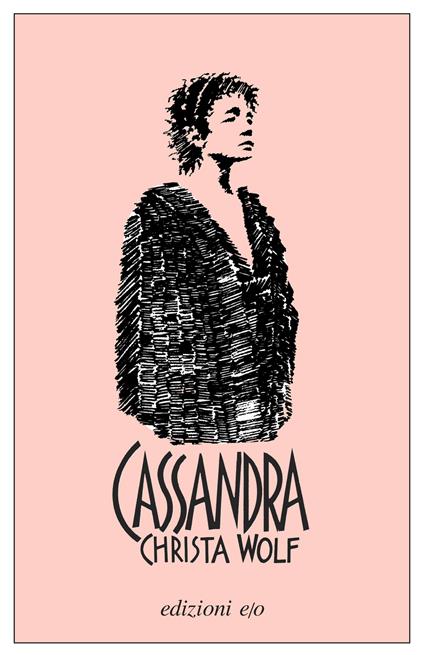
Conscious of the inadequacy of literature to address “the phenomena we now face,” Christa Wolf nonetheless reconstructs in Cassandra (e/o, Anita Raja translator) the story of the Trojan princess who “sees the future because she has the courage to see the real conditions of the present” — and cannot help but do so in hindsight, as the protagonist is captured and about to reach the Peloponnese, where she will die shortly after.
The narrative voice is the priestess herself, who nevertheless leaves the author ample room for intrusion: to guard against the risk of objectification, both women speak and realize themselves in each other, and Woman becomes the counterpoint to an epic made only of male battles and walls that appear impregnable (from Ilion to Mycenae, from Auschwitz to Berlin, almost without interruption).
The weapon of Cassandra, for her part, is the only true lever capable of (re)raising the world: the gaze.
Seen as testimony and as a point of view, but also as a narrative alternative of herself and of reality, demythified and uncensored. A bloodless gaze, opposed to the terror-dominated one, but one that should not be expected to illuminate the master path.
The maximum to which she can aspire is to name it, tearing it away from institutional hypocrisies to put it at the service of the individual and the community, stripped of the deceptions of those who wield power to uproot any spark of anti-conformist initiative.
Yet, faced with others’ blindness, Cassandra’s effort is thwarted and demeaned: to see is a misfortune, just as sharing what one observes “with love and precision” is if the crowd is not ready to embrace the crisis in which it finds itself. Christa Wolf reminds us of this with a language that is dense and laconic, letting the work’s structure become progressively more unraveled.
The protagonist holds more and more questions on the tip of her tongue, surrounded by men who would like to bind her to themselves in every possible sense, and she hides behind a prudent shroud of refusals—yet leaves a few breaches here and there, in a desperate bid to connect at least with those who will read her, convinced that only through pain, “afterward, if we meet again, and if a After exists, we will be able to recognize each other” and save each other.
…And Alone Like Medea (1996)
We hold the key that opens every era, sometimes we use it without shame, we glance quickly through the crack in the door, stubbornly making snap judgments, and yet it should be possible to approach step by step, respecting the taboo, prepared to wrench from the dead their secret not without pain.
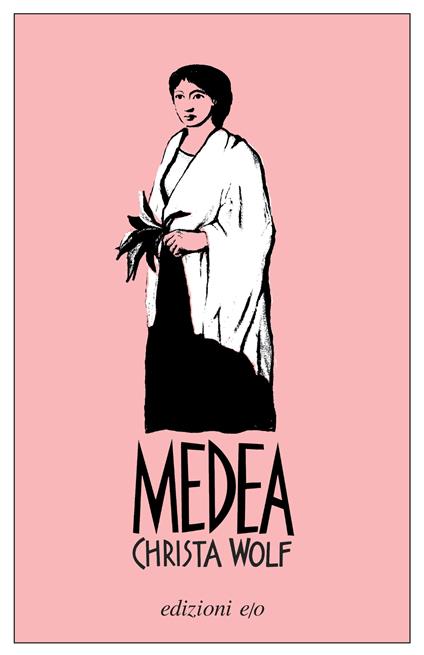
After completing Cassandra, Christa Wolf once again plunges her hands into the Greek myth to undertake a rewrite of Medea (e/o, Anita Raja translator): an experiment that revolves around the same warning as Cassandra about emancipating from the violence of patriarchy, though it unfolds within a very different frame.
We are in 1996, thirteen years after Cassandra’s publication and seven after the fall of the Berlin Wall, and a united Germany today bears another face. The author had already begun to address this in 1990 with the publication of What Remains, a semi-autobiographical novella in which she talks about a writer surveilled by the Stasi and her sense of estrangement in the new German reality.
However the work sparked strong controversy, compounded by the discovery of a brief collaboration Christa Wolf had with the secret police between 1959 and 1962, which had in fact been terminated by the authorities after a couple of interviews, in light of the insignificant statements she made.
When the only ally she has is now the friend Günter Grass (1927-2015), and she has to accept for the first time a nine-month fellowship from the Getty Foundation in Los Angeles, the writer experiences first-hand the hostile marginalization faced by those deemed inconvenient, dangerous, or bearing a truth too complex to be reduced to silence.
From here begins the philological investigation through which she seeks to debunk the Euripidean version of the Medea who killed her children, jealous and bloody, that has reached us: what if the foreigner in Corinth was rather a misunderstood healer, a figure independent and thus unbearable, who forced the city to neutralize her before challenging its status quo?
After all, unlike Cassandra, Medea’s wisdom focuses on the past and the hidden plots from which present trends originate. Her boldness is tragic and urgent, and could threaten the government’s corruption if not for a swarm of third voices that begin to buzz around her (even in the narrative layer) to muddy the waters, depriving her message of clarity and good intentions of her actions.
“A helping hand, I thought, why should they despise it,” the protagonist ponders. Then she bitterly concludes: “Because they can only temper their fear with fury against others,” stifling in repression the fear of difference, and for centuries placing a monstrous mask on those who dare deviate from the script written by the winners.
Speak, so we may see you (2012): Christa Wolf without mediations
One can at least learn what not to do. That’s something. And then I hope that intergenerational dialogue will not remain completely sterile. I notice that the younger generation questions us older people with great intensity and genuine interest. And I have the impression that with the younger ones it is possible to speak freely and without mutual prejudice.
In the following decades, Christa Wolf keeps herself increasingly away from the limelight, dividing her time between her historic apartment in the heart of former East Berlin and a countryside house in Woserin, in Mecklenburg, where she loves to enjoy the summer with her husband.
Although she does not identify with the capitalist values of the country she lives in, she never “hangs up her pen,” driven by the need to delve into herself, by the ethical duty to keep questioning the wounds the 20th century inflicted on Europe, and by the bond of solidarity she maintains with her audience of old, who still sees in her a beacon to follow.
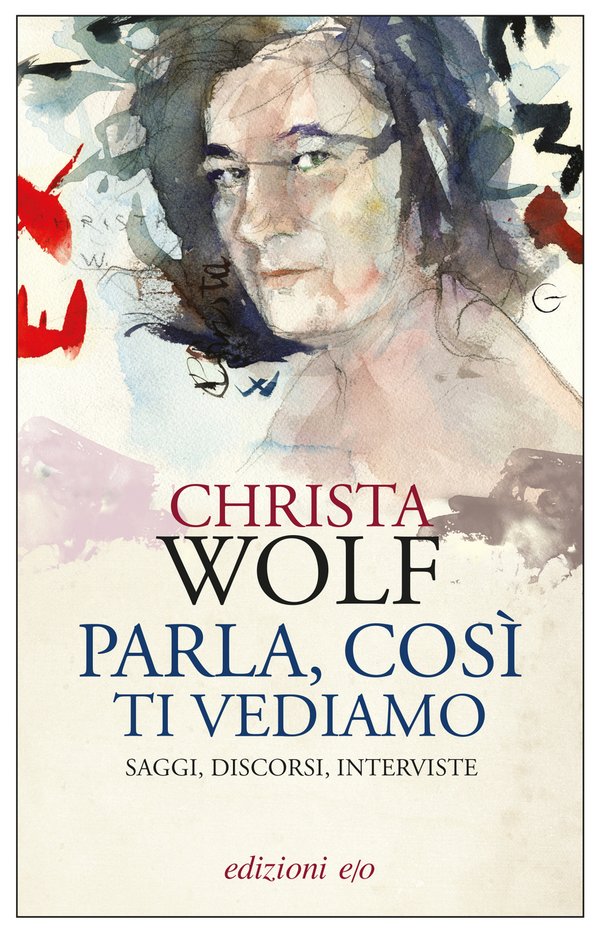
It is in the name of this partnership, gradually reestablished with the academic community as well, that in 2012 Suhrkamp Verlag publishes posthumously the volume Speak, so we may see you (e/o, Anita Raja translator), collecting the reflections, speeches, letters and especially the interviews born from the sporadic opportunities for confrontation that had punctuated the author’s mature years.
The title echoes a famous Socratic exhortation, to which, despite her painful past, Christa Wolf evidently agreed to lend an ear until the end: to offer herself to her interlocutors without denying or sugar-coating her own positions—and weaving with candor the exploration of her subjectivity together with a review of sociopolitical phenomena most familiar to her.
Among the pages of the book, many knots concerning the author’s relationship with the DDR are untangled; we glimpse the composed discretion of her temperament and come to terms with a steadfast mind that, for a lifetime, tried to stay away from blind spots, fictions, and moral shames, even when exposing herself could have risked her safety.
Since then, the debate about her remains open to this day, even though the Bavarian Academy of Fine Arts and the city of Lübeck awarded her the prestigious Thomas Mann Prize in 2010, one year before her death due to a long illness.
If, beyond her frequently contested opinions, Christa Wolf is nonetheless to be considered one of the central figures of contemporary German literature, whose works remain indispensable for anyone wishing to approach the anxieties, the ethical dilemmas, and the identity fractures that have characterized Europe since the mid-20th century.