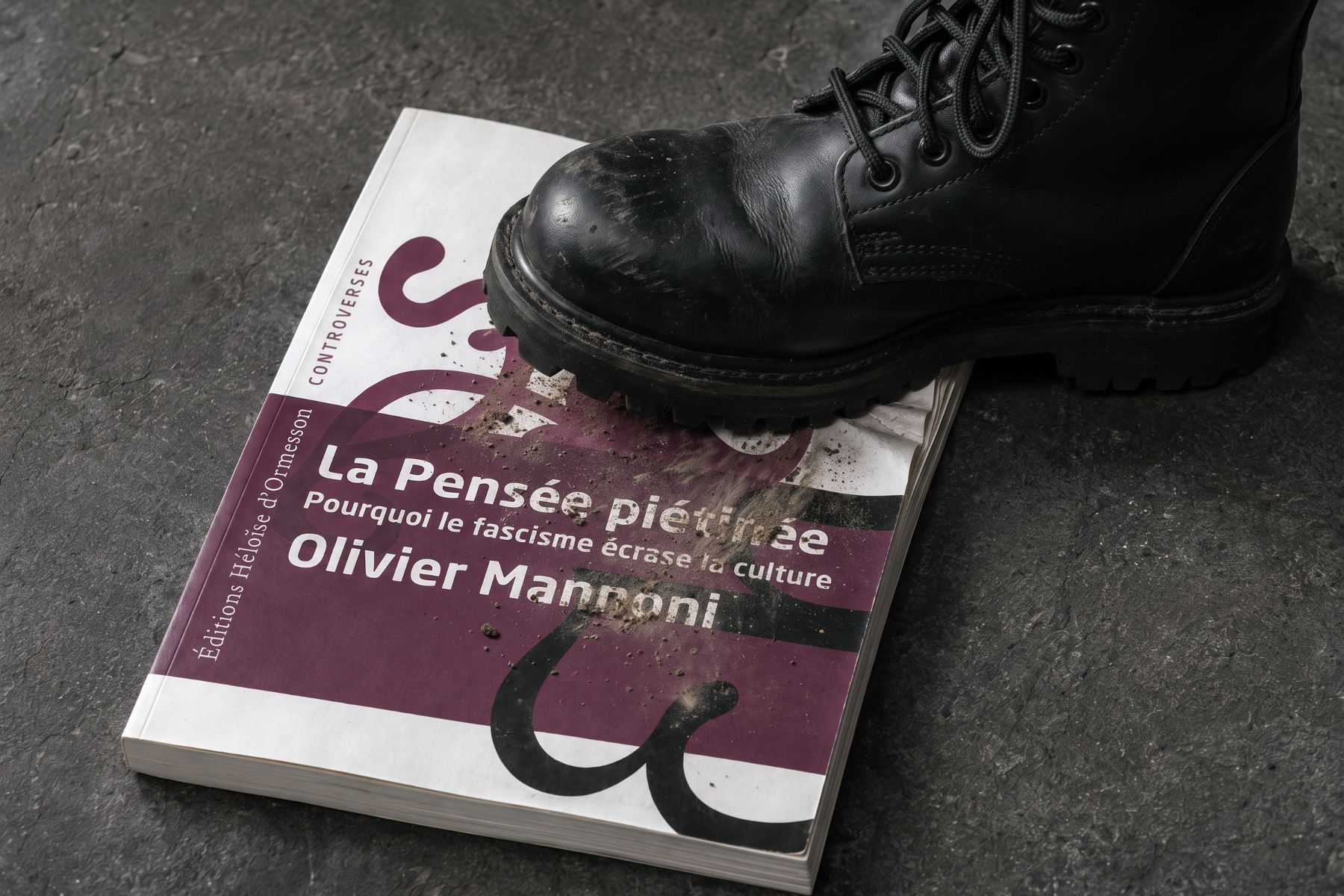
Olivier Mannoni, The Stifled Thought: Why Fascism Crushes Culture, Héloïse d’Ormesson Editions, 08/10/2026, 208 pages, 16€.
The translator of Mein Kampf wields ferocious irony. Olivier Mannoni spent eight years immersed in Adolf Hitler’s prose, translated from German more than two hundred books, founded the School of Literary Translation, and in March published a satire, Back to the Roots. Anatomy of a Political Farce. Following Translating Hitler and Brown Plunge, The Stifled Thought, published by Héloïse d’Ormesson Editions, completes a triptych on fascism. In it, we laugh at censors before hearing them trample.
The Circus of Censors
On April 2, 2026, before the public broadcasting inquiry committee, Xavier Niel reproached rapporteur Charles Alloncle for turning the inquiry into a circus and told him “I am not a clown”. Another deputy, Matthias Renault of the National Rally, called for ending subsidies to Trans Musicales, an association he accused of hosting festivals of transgender artists. Their name signals the diversity of musical genres. In Thomas Jolly’s Olympic bacchanal, a faction of the right that presents itself as Catholic discovers a blasphemous Last Supper, around a blue Bacchus in which one might have recognized, in China, a Smurf. As for the green of a floating Kermit the Frog displayed on Place Vendôme, Isabelle Marchandier reads in Causeur the idol of a climate paganism. Olivier Mannoni is surprised that she forgot to read the green of Islamo-leftism there as well.
Henri Bergson saw in comedy the “mechanical overlaid on the living.” In each of these scenes, indignation springs from a single word or color, with the regularity of a spring that was already winding in 1863 when Édouard Manet’s Luncheon on the Grass was banned from the Salon and relegated among the refusés. Émile Zola defended him, reminding us that the Louvre still hung more than fifty paintings that mixed nude bodies with clothed figures. In 1937, the Munich exhibition of degenerate art purported to display works by mentally ill artists, yet enthusiasts crowded in to admire Paul Klee or Emil Nolde, whose canvases risked vanishing. The reactionary right reserves its fury for living culture, while the heritage it claims to defend was often the scandal of its time.
Olivier Mannoni makes a timely distinction by refusing to dignify this fury with the name of cultural war, for the far right, short of creators, relies on the cult of the past and the charge of decadence, which the book finds intact in Joseph Goebbels as much as among Donald Trump’s adherents. His war targets culture itself, with the aim of killing it. The prologue makes it the canary of the rule of law, a bird whose suffocation announces a gas explosion.
The Clampdown and the Magnates’ Face
Alfred Hugenberg, master of Ufa and an immense press empire, had lent his newspapers to the Nazis before joining Adolf Hitler’s first government in 1933, only to be stripped of influence by the regime. Olivier Mannoni calls him the butt of the joke and suggests today’s magnates remember that dictators have little taste for debt.
The essay recognizes Vincent Bolloré as the French counterpart of Alfred Hugenberg. In 2016, a strike at i-Télé led to the departure of three-quarters of the newsroom and opened the door to CNews; in April 2026, the dismissal of Olivier Nora bled Grasset in a single day. Fayard, the house whose passage Mannoni traces in service of the far-right, had published in 2021 the critical edition of Mein Kampf that he translated, while Translating Hitler appeared the following year at Héloïse d’Ormesson, entirely independently, within a group then belonging to the Bolloré galaxy. Four years barely separate this freedom from the Grasset affair. When Vincent Bolloré castigates in the Journal du Dimanche a “small caste that thinks itself above all,” Mannoni hears the resurfacing of a Hitlerian idea, that of a caste of artists and thinkers cut off from the people, which Jean‑Marie Le Pen had already turned against teachers in 1984.
In the autumn of 2025, the National Rally sought to close the National Center of Cinema, and deputy Sébastien Chenu proclaimed that a good film is judged by its box office. The essay counters with the 2024 Largo Winch, with a budget of seventeen million euros and 404,000 spectators, compared to Anatomie d’une chute, touted as elitist and backed by CNC advance, which had drawn nearly two million. Mannoni’s argument persuades when he shows that budgetary strangulation, practiced by managers of all stripes, paves the way for a return to control. In Washington, where it is endured, Donald Trump had his name inscribed on the Kennedy Center’s façade until a federal judge ordered its removal, and he then announced the venue would close for two years.
Yet the coup against Grasset backfired. In the wake of Olivier Nora’s dismissal, more than a hundred authors announced that their forthcoming books would leave the Saint‑Germain street publishing house. Bernard-Henri Lévy joined Virginie Despentes, with whom he has almost nothing in common, in a rare show of solidarity among writers. Olivier Mannoni reads in this a clear truth: creators are not cannon fodder.
Knowledge for Sale and the Right to Slowness
When Nicolas Sarkozy mocks schoolteachers who would work twenty-four hours a week, six months a year, the same reflex targets knowledge itself, in a country where a secondary school teacher earns almost twice less than a German counterpart. Since 2014 the list of colleagues murdered for various motives has grown, including Samuel Paty and Dominique Bernard. Mannoni notes, with a chilling humor, that the management controllers have escaped that fate, though they earn roughly half more with the same degree. Across the Atlantic, the Trump administration cut climate researchers from satellite data, to the point that oceanography, as a result, has become blind.
In the final chapter, the stiffness that mocked the censors becomes, among those whom the author calls silicone titans, a project of dehumanization. A spring 2026 advertisement for ChatGPT proclaimed “Everything is designed for you”, a slogan Mannoni points to as a terrifying double meaning, since it consigns to the machine the very task of thinking. In a clip viewed four million times on YouTube, the singer Michael Bennett, gaunt with age, rebukes his own son for abandoning him. Michael Bennett seems to emerge entirely from a software. Against these automata, Mannoni invites us to defend, among other paths, a right to slow reading and dialogue, a practice he has shared for five years with high school students eager to understand the drift of language. He argues that the book should be read before the 2027 presidential election, which the essayist approaches with argued concern, to learn to detect, beneath an amendment or a shareholder vote, the assault on intellect.
Marching to the sound of boots, Mannoni opposes to what they dread a thinking that laughs, dreams, and a canary at the bottom of the mine who still breathes.
The article The Stifled Thought or How Fascism Crushes Culture first appeared on Lythrum Press.