
What do we seek, in an author, within the texts they write? Usually, a point of view on the world that also functions as a spur for reflection, or at least an experience of interpenetration that makes us familiar with their value system.
Yet, from time to time, it can happen that we encounter books that permit us to observe from a privileged angle the explicit way in which a writer has changed during the period required to give life to that work.
It happens often with memoir and autobiography, as well as with epistolaries or poetic sequences, but not only…
I Take Care of the World through the Chronicles
She wanted to know whether I would take on the effort. In truth, I already feel committed. Everything I write is bound, at least inside me, to the reality we live in.
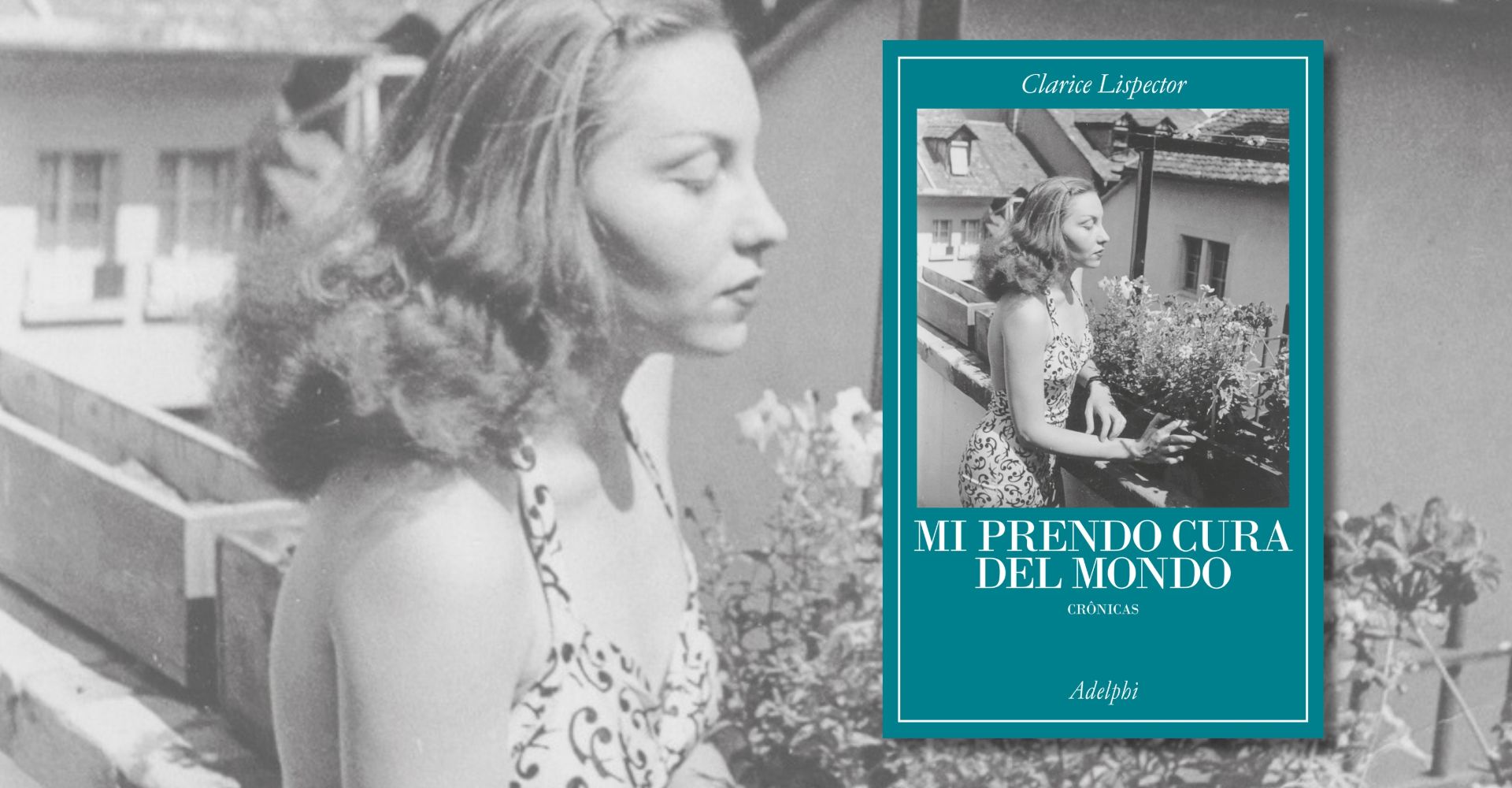
This month, for instance, the volume I Take Care of the World (Adelphi, translated by Roberto Francavilla and Elena Manzato) by Clarice Lispector (1920-1977) returns to shelves—one of the greatest South American writers, translators, and articulators of the 20th century, who is responsible for some of her most renowned and accomplished works, such as The Passion According to G.H., Family Torths, and A Breath of Life.

to be collected in the volume (strongly desired, moreover, by Paulo Gurgel Valente, Lispector’s heir and who wrote the book’s afterword) are Lispector’s crônicas published in her lifetime, a discipline she practiced regularly from the 1940s to the 1970s as a form of Brazilian journalism—defined as a brief and informal narrative treatise that begins with a everyday episode and then broadens to more ambitious topics.
Naturally, such an editorial operation is interesting in itself, given the variety and the breadth of the contents it contains, but what makes it even more remarkable is its ability to reveal something about Lispector that we previously overlooked when viewing the text through a “crônica-diaria” lens.
Sic parvis magna
I have already published in newspapers, unsigned. Signing, though, would automatically make me more personal. And I feel a bit as if I were selling my soul.
To steer us in the right direction, it should first be noted that it was for primarily economical reasons that the author agreed to collaborate every Saturday for six years with Journal do Brasil—one of the country’s oldest and most prestigious dailies, and on whose pages most of her contributions would appear, occasionally hosted by O Jornal, Senhor, Joia and Última Hora.
It was the summer of 1967, and she was already a prominent figure in the cultural scene, though she was not used to writing for the press and had a blurred image of her audience, or of the discourses for which it would be worth digging in.
In the beginning, then, it is almost inevitable that Lispector stumbles a little.
She shows up punctually to the appointment with her white-column column, but admits feeling uneasy and tries to sidestep her shortcomings by letting the early chronicles alternate between exchanges of surreal quips with taxi drivers, heart-wrenching social appeals, pens that unseal Pandora’s jars on her role as mother, nuns leaving convents only to lose their minds and unusual messages to journalists and printers.
So much colorful trinketry, stacked atop the previous, building a Babel Tower of tinkles of thought. At least until the great writer within her decides to reveal every one of her most remarkable golden nuggets.
The Writing as Reanimation
And once changed, my way of writing would certainly have influenced me too—and I would have changed in turn. But in what sense? For the better?
Thanks to a prodigious turn of pace, in fact, suddenly in her interventions there emerge singular tensions between animalism and death, or between God and good cooking, impressionistic sketches of places such as London and Bahia, and a couple of blazing interviews, among which stands out the one with the famous Chilean poet Pablo Neruda.
After she gathered the world from the ground and unfolded it page by page, month by month, it would seem that the practice and the perseverance had suggested to Lispector a magical formula for becoming the one who can re-animate the elements of creation, thereby endowing each of them with a new soul.
An undertaking not to be underestimated even for a multi-faced mind like hers, that of navigating so boldly between domains that, though always different, consistently preserve freshness and relevance. But what will have changed in her approach to the chronicles to allow her to reach such heights? How did Clarice Lispector manage to surpass herself?
I Take Care of the World to Give It Meaning
In her humility, she forgot that she herself was a source of life and creation.
On one hand, undoubtedly, she will have let herself be less guarded and dared more, after realizing that on the other side of the page there was no one ready to ridicule her or stir up controversy, and that instead a silent veil of respect was being woven with the readers of the newspaper.
On the other hand, she will probably have come to terms with the idea that life may not have an intrinsic sense to reveal and contemplate without blemish, sensing that what gives it depth is perhaps the relationships that worldly things establish with each one of us—nor forgetting the story, tangled yet authentic, that we will be able to extract from that encounter.
A transformative revelation, which at that moment would have encouraged her to give citizenship to as many versions of her relationship with existence as possible, in the hope of highlighting its impasses, its wonders, and its spirals.
“The Path Is Us”
It seemed like pain and, in human and animal terms, it was. But was it pain, or was it a “going,” a “going toward”? For what is alive moves forward.
Certainly we are still talking about “snippets of a reality that eludes her” in its entirety, as the translators’ note closing the volume states—divagations inspired by a chipped teacup lip, a jasmine, the sea at dawn. But precisely because she persistently pursues all of this, Lispector manages to sharpen her role as a mediator between the realm of the visible and the more allegorical one to which she leads us.
And it is precisely her constant sharing of aims and trials that reminds us that behind the most satisfying drafting of a text there lies always “a path, and the path is not only a means. The path is us. When it comes to life, one can never arrive early. The Way of the Cross is not a deviation; it is the only possible journey.”
The same journey that, in I Take Care of the World, will present a Clarice Lispector empathic, sharp, and pulsating to those who know how to wait for her to unfold gently between the lines of time…
