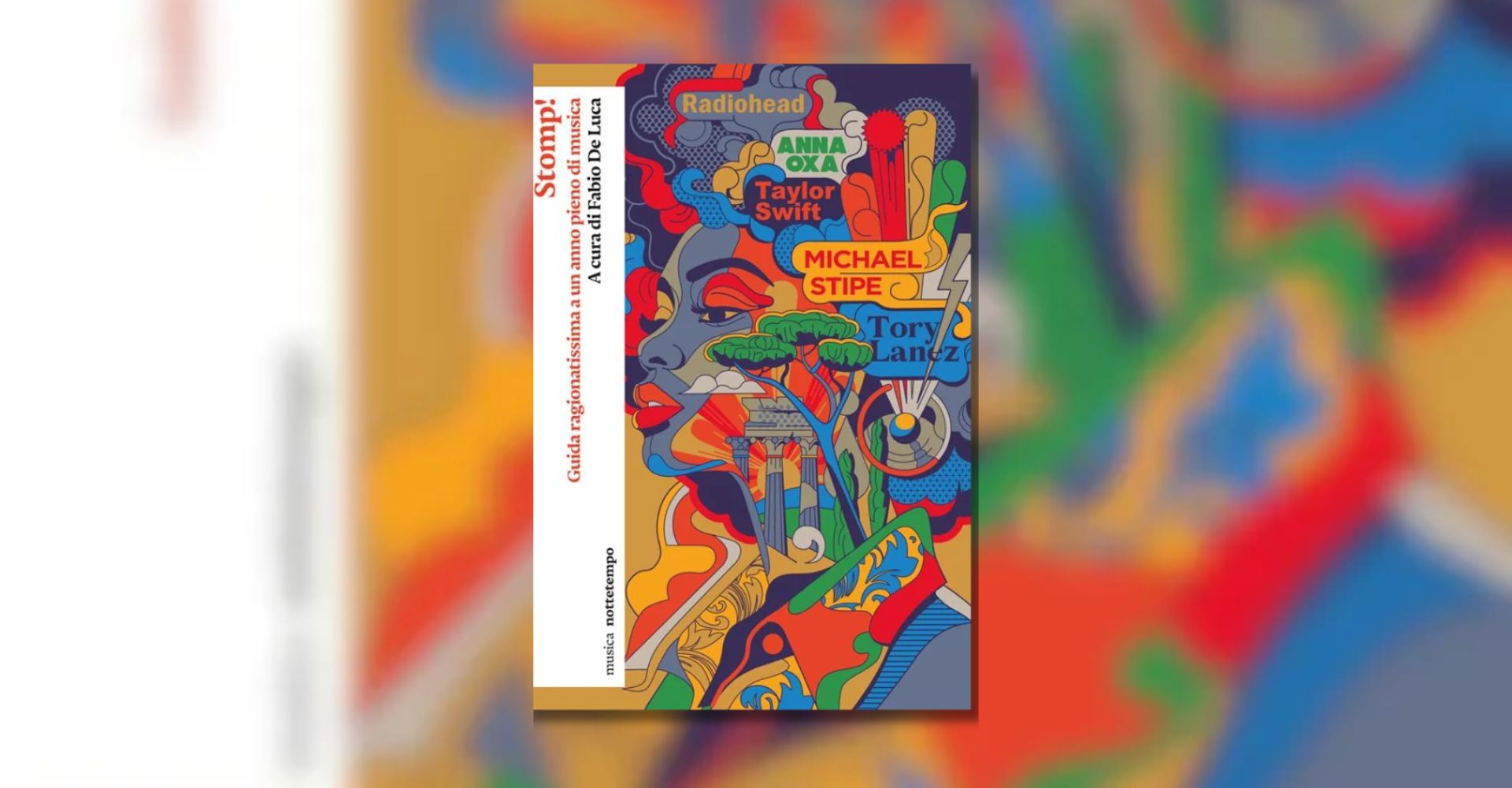
Just a few weeks ago in bookstores, from the nottetempo press, a volume that anyone who has spent a life among records, magazines and concerts cannot help but eye with interest: Stomp! A Thorough, Well-Reasoned Guide to a Year Full of Music, curated by Fabio De Luca. A book that tackles in a particularly original way a question that those who write about music have been asking themselves for years, often with a certain melancholy: is it still possible to get lost in music, in an era of 120,000 tracks uploaded every day on platforms, of the algorithm that chooses for us, of concerts that cost as much as a cruise?
Was there a need for another book on the state of music?
Was there a need for another book on the state of music? The debate is tired, yet this attempt, thanks to its polyphonic nature, remains lively and still intriguing.
Because De Luca rejects both of the most trodden shortcuts: the nostalgic lament for a golden age lost and the uncritical enthusiasm for the new that advances. He instead chooses the form of an almanac: twelve months, each opened by a “Player,” a montage of dates, anecdotes and small epiphanies (from the first, terrified Prince concert to the Bowie Bonds, from Dylan’s electric shift to Cage’s 4’33” silence), and then inhabited by twenty-six contributions from authors as diverse as they are. The curator compares it to the “mystery envelopes from 1980s newsstands,” a value in reality modest but a perceived value enormous: feigned modesty, because the result is one of the most successful ensemble books of recent years.

The variety of contributions is the first merit:
the moving memoir (
Max Collini, a child struck by the
Oxa, “dressed like a London punk,”
Luca De Gennaro who crosses the Paradise Garage threshold with a Keith Haring ticket in his pocket),
the theoretical essay (
Federico Pucci on the error as the last trace of humanity against “plastic music,”
Carlo Antonelli against nostalgia),
the militant genealogy (
Giulia Siviero, from the chants of the Roman Feminist Movement to
feminist reggaeton),
the philosophical reflection (
Federica Gregoratto on
the songs of dislove), and still dystopian storytelling, satire, and a chronicle from the future.
A focus on three reflections
Among the many reflections, three stood out most to me, also given my long-standing intellectual engagement with the authors, at various levels.
The first is Massimo Palma’s, and those who read his books, from Happy Diaz to Desiderare Bowie, will immediately recognize his signature: tackling huge themes with a lateral, disorienting approach, built on apparently wayward juxtapositions that, by the end of the journey, leave the reader enriched with a new perspective. In his Get Back? it happens again. Palma takes on the most toxic word of our present, “remigration,” and flips it, showing how rock, from Woody Guthrie to Springsteen, from The Specials to Lana Del Rey, has never sung the homeland but the road, the transit, the drift. “And if they remigrated us, we would not know where to return.”
The second is Alessandro Gori’s, who in When Gianluca Grignani Died starts from a metropolitan legend of 1995 to build a little masterpiece of grotesque: a provincial classical high school, janitors acting as lookouts, mushroom-filled Sofficini before the TG1, a self-destruction that later appears on the Roxy Bar couch, a simple haircut. The transfiguration is comic to the surreal, and yet the effect is profoundly sincere: beneath the deformation lies the truth of a youth in which a pop idol could steal one’s sleep, and the guilt for a pain entirely imagined was the most real feeling.
The third is Liborio Conca’s, who with Diranno che sei vecchio signs a piece as brilliant as the pun by a “sorcino” that gives it its title. At the center is Michael Stipe, a “refined beat sage” with a long white beard reminiscent of Whitman, who dissolved R.E.M. at fifty and has not turned back: no reunion, no farewell tour, only photography, activism and a few rare songs. While the Rolling Stones try to appear younger with deepfake, Conca reminds us that aging without makeup is a choice, and perhaps the rockiest of all.
The times, as the greatest sang, are changing
What holds it all together is De Luca’s writing, with an almanac-like irony that never slides into cynicism: the trial of U2, the page on Ancora tu by Battisti as a mirror of Italy in 1976, the piece on Ultimo and the contemporary possibility of being wildly famous and utterly unknown at the same time, the visit to Rick Rubin in his Tuscan village, suspended between fascination and suspicion.
A generous book, dense with insights and unpredictable juxtapositions, inviting us to truly listen again, with the body before the mind: as the inventors of that stomp did, stamping their feet on the wooden floors of the poorer New Orleans venues, the place where the volume’s title originates. The times, as the greatest sang, are changing; the need to beat time, fortunately, remains.