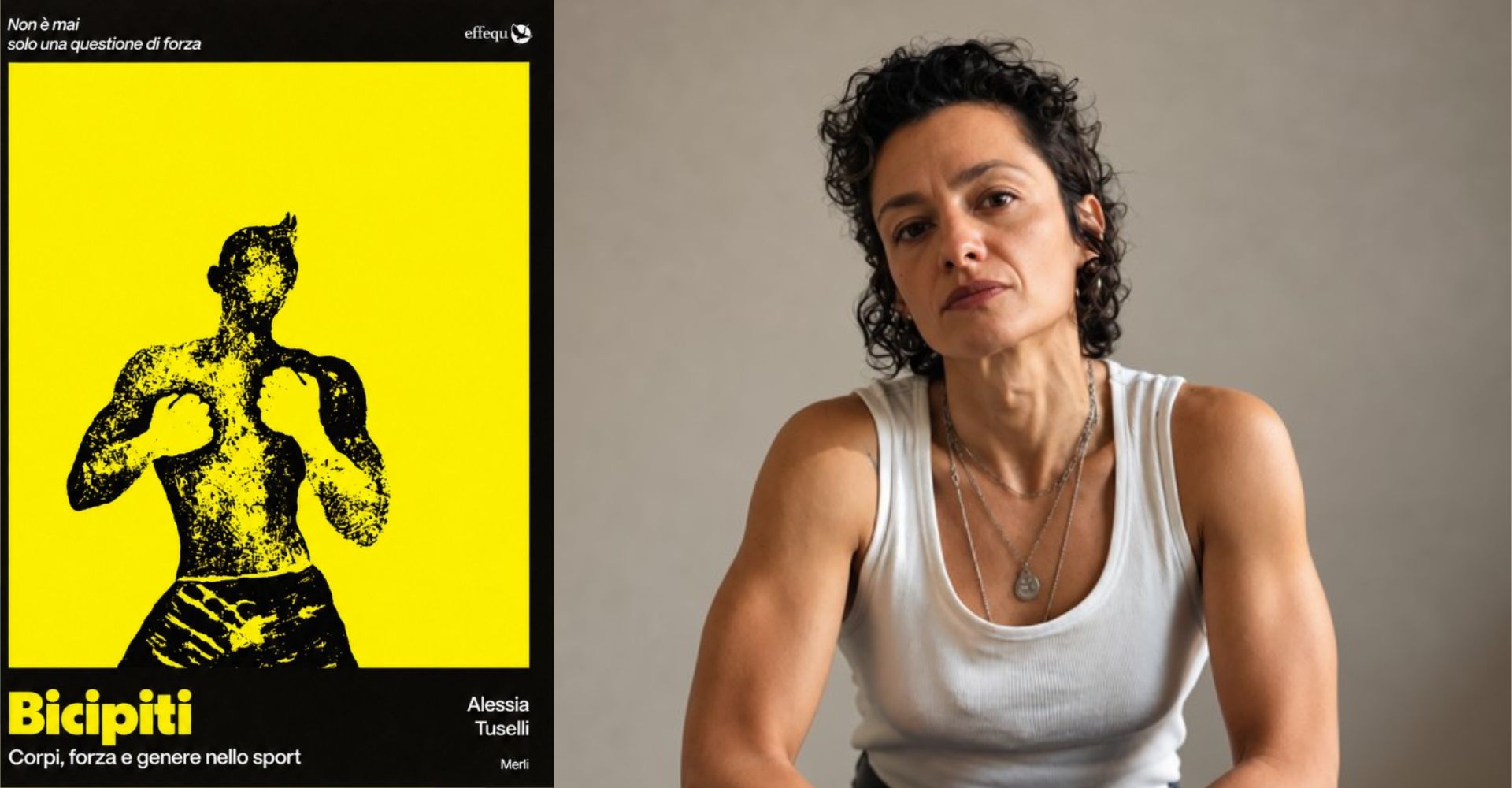
“Strength is never just a matter of force”—indeed, because in Alessia Tuselli’s new essay, Biceps – Bodies, Strength, and Gender in Sport (published by effequ), strength is no longer merely performance or pushing beyond limits; it becomes the way the body makes space for itself and insists on being heard.
The book begins from the observation that, although a muscle is simply a natural consequence of a trained physique, sports culture has long charged muscles—and the biceps in particular—with virility and masculinity; thus, when they appear on bodies that “shouldn’t have them,” they become excessive and undervalued aesthetic elements.

Travelling through sport as the space where “strength is desired, measured, and watched over,” this volume engages with hyperandrogenism, trans athletes, intersex bodies, non-conforming bodies, and the menstrual cycle, with the aim of building sports spaces that are less exclusive and violent, and more habitable.
The author is a sociologist and a researcher at the Center for Interdisciplinary Gender Studies at the University of Trento, dedicating herself to topics such as the representation of bodies and gender categories in the sports sector; one of her essays is included in Fundamentals – Stories of athletes who changed the game (66thand2nd, 2024).
“You look like a man: it’s the thing people tell me most often,” says Benedetta Squillante, a powerlifter specializing in the bench press and an Italian personal trainer, in a reel on her Instagram profile. “Return to being a woman”; “Woman? I don’t see one”; “You’re awful”—these are among the comments that recur under her videos and posts.
Arms, thighs, and shoulders occupy space, doubling in volume: in Squillante’s body, the building of muscle is recounted as a practice of self-determination, where the bicep ceases to be something to hide and becomes a volume of situated knowledge. It is written into her body, one of the athletic and aesthetic elements of her narrative. In this way the category ‘woman’ acquires its own meanings, dismantling, volume by volume, the boundaries that separate strength from femininity deemed acceptable. In an era when the bodies of people assigned female at birth continue to be narrated as objects, often reduced to single, white, heterosexual, slender, able-bodied stories, there are personal stories and self-representations that find a home in sports contexts. One such space is weightlifting. In a 2025 Instagram post, Ilona Maher, a U.S. rugby player and Olympic bronze medalist, proudly displayed her “normal and healthy stomach,” explaining that not having sculpted abs does not make her any less athletic or strong. A deconstruction of the model of the ‘athletic body’—an aesthetic ideal with a specific variant: Maher self-determines her own body.
With irony she invited people to “be kind to your own body” and to accept that strength and beauty take different shapes. Maher puts herself forward and unveils herself, asserting the body as a desirable place: “I love that rugby has shown me what I am capable of doing. It made me realize what my body is capable of, and that it’s not just something to look at and objectify.” In the September 2024 cover of Sports Illustrated, dedicated to representing the bodies of athletes who do not conform to traditional models, Maher becomes an icon and a contemporary role model: she shifts the boundaries and possibilities within the body. She performs a shift in meaning, from how a physique should be to what that physique can do or is called to do. She reflects on being frequently described as ‘masculine,’ and how rugby helped redefine her relationship with herself, with physical dimensions, and with the standards of femininity. Not the abs or the mainstream “body positivity” prescriptions, but a representation of body functionality, the normalization of volumes. In a contemporary moment that seeks new narratives (even from fashion and sports brands) about women’s bodies.
We have witnessed the male gaze’s rules for shrinking female-assigned bodies to the point of fit. Yet there is a moment when the boundaries of the “woman’s body” contract with a quiet, though publicly loud, force: that moment is the Eighties and the strength of aerobics. Jane Fonda arrives, and with her, a new ideal of body to aspire to.
Although she herself intended to promote physical discipline as a form of female liberation with the cry of “break the weaker sex mold,” feminist studies show how aerobics could be placed within an “axis of continuity” with the popular culture of the Eighties that idealized, disembodied, and diminished women. Jane Fonda and aerobics mark that shift in meaning where the lean body becomes the shared symbol of beauty and health. It is the historical period in which the intersection of diet culture, fitness practices, and growing aesthetic intervention on the body takes hold. The healthy body increasingly becomes a lean, toned body for both sexes: the difference lies in the space that body must occupy.
The bicep of Jane Fonda graced magazine covers, books, and video courses like Jane Fonda’s Workout Book, selling millions of copies in the Eighties, yet it is a bicep that differs from those of bodybuilders before her and the athletes who would come after: a bicep that does not upset because, in its toned form, it does not occupy space; it does not demand to. Courses like Jazzercise or Dancercise helped consolidate an athletic female ideal—slim, athletic, sexualized: aerobics functioned as a dynamic in which women are socially nudged to shrink their bodies, to be “in shape but sexy / strong but slim.”
There were attempts to challenge these aesthetic norms that have threaded through the decades since the Eighties: the Large as Life movement, for example, born in Vancouver in 1981, began offering aerobics classes exclusively for fat women. Between 1981 and 1984 the participants themselves started training as instructors, refining and sharing non-fatphobic practices, bringing the lessons to thirteen fitness centers in the Vancouver area. A collective practice of reinterpretation and reclamation of aerobics.
In contemporary times the process of re-signification takes shape along a different symbolic axis with athletes like Squillante and Maher. For them too there was a collective need to build a rhetoric of “acceptability”: Maher and Squillante are often labeled as muscle mommy. Large bodies that nonetheless, in popular imagination, fuse physical strength with care, as in the earlier linkage of physical prowess and femininity recognized aesthetically. A collective effort to render these athletes less disruptive, downscaling them in many ways and, moreover, turning them into figures desirable for the male gaze.
Muscle mommy is a category that condenses bodily registers traditionally kept separate. This figure answers a need to hold together muscle—still regarded as a male space—and care, the province of femininity, the fitness of the body and the “gentleness” associated with motherhood. A femininity that thus becomes almost “acceptable,” inside and outside sports contexts. They are new ways of naming women’s bodies that appear, therefore, less confrontational.
In this discourse the biceps thus take on a dual symbolic value: on the one hand they continue to bear the weight of the traditional iconography of male strength, on the other they open up to new interpretations in which musculature becomes a tool of agency, desirability, and collective resistance to rigid gender categories. A resistance that also passes through other bodies, not merely as tools for athletic performance but as political spaces.
Simone Biles forced the public to confront a new idea of the athlete’s body in gymnastics. A body that shows power and endurance, muscular volume and fortitude, capable of feats without precedent. A Black woman’s body that had to wait to occupy a position of power—thanks to victories, fame, and records—before she could speak. Biles spoke publicly about mental health and denounced abuse and violence within the world of gymnastics. Biles was the first to do so with a megaphone that could not be silenced.
Serena Williams redefined tennis through the discursive, aesthetic, and muscular practices surrounding her strength. The act of having her, using her, displaying her, dressing her or undressing her was interpreted as a problem primarily of aesthetics. At the 2018 Roland Garros, Serena wore a black and red catsuit, designed for her and intended to address a health need after blood-clotting issues that arose during pregnancy. Yet the suit, which compresses the body to aid blood flow and reduce the risk of clots, was deemed by the French Tennis Federation to be inappropriate and “disrespectful to the tournament and the venue.” The following year, the rules explicitly banned outfits that covered the body entirely and introduced a pre-approval system for players’ outfits. Elena Marinelli writes:
Labeling the catsuit as disrespectful to the tournament and its venue ends up quickly boxing the discussion off-field and elevating it to the level of the gaze of those watching.
Those same collective eyes then deemed her too powerful “to be a woman,” but never “as powerful as a man.” This mechanism is part of a broader genealogy that in tennis has a precedent in what the press called the Battle of the Sexes: in 1973 Billie Jean King defeated Bobby Riggs in a match that was transformed into a highly mediatized symbolic test, at a moment when the value of women’s sport and the athleticism of female athletes were constantly belittled. In 2017, John McEnroe revisits this rhetoric in an NPR interview, while still calling Williams the best female tennis player “of all time,” he insists that in the men’s circuit she would have been “roughly number seven hundred in the world.” The debate becomes international, reproducing a familiar narrative about Serena Williams’ body and not only: that the physical power of the tennis player exceeds the boundaries of female athleticism and, precisely for that reason, should be verified, measured, in comparison with men. Some articles even proposed mixed-gender matches as a solution to determine the “true” value of her strength. As the Washington Post notes, the very fact that in 2017 there was still talk about whether a female athlete should beat a man to be fully recognized reveals the persistence of an implicit rhetorical hierarchy. The measure of athleticism remains the male body. In this narrative, Williams’ power is read ambiguously: celebrated as an exception, yet used to continually push the standard evaluation beyond her career and her victories. Thus Serena Williams’ body becomes a field of symbolic tension: too powerful to fit the traditional codes of sports femininity, yet precisely for this reason compelled to be reinterpreted, measured, and scaled through comparison with the masculine. It is precisely in this tension that the political significance of her presence resides: a body that forces public discourse to reveal its limits, showing how recognition of female athletes still mostly passes through comparison with, and subordination to, an implicit male model.
In this narrative, what was once thought to be an exclusive sign of masculinity—the flexed arm, the displayed muscle—becomes a symbol capable of redefining the relationship between gender, strength, sport, and representation. The bicep of these bodies breaks the exclusive sign of virility, and becomes an emblem of self-determination, of resistance to normative gender models, of athleticism, of beauty. It is a way to revolutionize the social meanings of strength.
From the nineteenth-century spectacle of strongmen to images of contemporary bodies, the biceps is a symbol in which categories and meanings intertwine: from a promise of male domination to a language of reclamation, open to new subjectivities and new forms of identity.
Olga Campofreda writes: “Some sports narratives inevitably shape the textures of new genealogies, where lines of descent are traced through the repetition of specific gestures, styles, and performances to be showcased.”
This display as public and symbolic affirmation meets a stubborn wave of backlash, both inside and outside sport. Because these bodies break boundaries, push physical and cultural limits that we collectively assign to the ‘woman’s body.’ Thus the attempt continues, again and again, to tighten, to narrow: boundaries, categories, bodies themselves.
© Alessia Tuselli 2026
© effequ 2026
(a differenza della versione originale, qui non sono indicate le note)
(continues in bookstores…)