
Can the music we listen to every day influence our literary tastes?
A question obviously rhetorical since — thankfully — the dialogue and mutual influence between music and literature are a constant in the cultural world. And in some cases, the passage from an artist, a playlist or a particular band to a book to keep on the bedside table is entirely natural.
But what happens if we try to pose the same question when thinking about rap music?
A genre with its own very specific audience, which has often been associated, sometimes unfairly, with a series of negative stereotypes. Whether due to the direct, unfiltered, and frequently “politically incorrect” language, or the imagery linked to suburbs and street life, one would hardly expect rap to become a vehicle to bring young people closer to literature — a culture sometimes perceived as too “high” and too distant. Yet there are, on occasion, unexpected exceptions that demonstrate the exact opposite: this is the case with Kid Yugi, one of the most interesting figures on the rap scene of recent years.
A career of record-breaking feats: at only 25 years old he boasts 27 platinum records, 20 gold records, over 2.5 billion streams and 3.6 million monthly listeners on Spotify. He has collaborated with practically everyone in the rap, trap and beyond: Tedua, Tony Boy, Noyz Narcos, Ernia, Nitro, Lazza, Geolier, Simba La Rue, Shiva, Sfera Ebbasta, Anna, Franco 126… But also Jake La Furia, Guè, Salmo, Mace, up to the opening of Marrageddon in 2023.
Not for nothing is he among the 100 most certified Italian artists of all time. But what does all this have to do with literature? And who is really Kid Yugi?
Kid Yugi: not only rap, but anime and literature
Francesco Stasi, the real name of Kid Yugi, was born in Massafra, in the province of Taranto, in 2001.
He started rapping as a kid with friends, during high school. But success didn’t come right away: “I was the worst of all, my recorded voice sounded awful,” he recalled in an interview with Gianluca Gazzoli for the podcast BSMT.
The stage name Kid Yugi is inspired by Yu-Gi-Oh! and by his passion for anime. A passion that, throughout his career, has emerged in several lines of his songs. Parallel to anime, however, since adolescence Kid Yugi has also nurtured another interest: literature.
“Stare tra i libri mi calma”
Kid Yugi is indeed one of the few Italian rappers of the new wave of very young artists, along with the peer Madame, who frequently talk about books — both through subtle references in his tracks and in interviews: “Stare tra i libri mi calma, in libreria ci sono i pensieri migliori del mondo e non ti urlano addosso, but wait for you to come and find them,” he told Gazzoli, where he also recommended three favorite reads: Una banda di idioti by John Kennedy Toole, Trilogia della città di K by Ágota Kristóf and Follia by Patrick McGrath.
The passion for literature, he says, began with Crime and Punishment by Fyodor Dostoevsky, a gift from his grandfather during childhood. A passion that eventually led him to enroll in the Faculty of Humanities at the University of Bari (a path later interrupted to devote himself to music).
It’s no coincidence to note the numerous references to literature, theater, cinema, philosophy and religion in the lyrics of his songs.

I primi due album: Shakespeare, Čechov, Il Maestro e Margherita e i Fiori del Male
To begin with, his first studio album The Globe, released in 2022, is a direct homage to the London theater of the same name where William Shakespeare performed with his company in the 17th century. A title chosen to evoke the parallel between street life and rap subculture and theatre, both defined by fiction. It features tracks such as King Lear, Sturm und Drang and The Chekhov’s Iron, whose lyrics blend street crime with the Russian theatrical tradition of Chekhov, where the rule implies that if a rifle appears during the play, by the end someone will shoot.
“Hatred will always be mutual
You change my face, turn me into a symbol
Make it known that I’m plummeting
Kid Yugi anti-hero, Antichrist
The Chekhov’s iron takes my breath away”
(from The Chekhov’s Iron)
Russian literature then returns in his second album, The Names of the Devil, released in 2024, whose cover is inspired by the chapter of The Satanic Ball from The Master and Margarita by Mikhail Bulgakov. A dark, theatrical image in which Kid Yugi sits on a throne of bones while a swarm of the damned bends at his feet.
“Eva, escape and go away from my life
Because my heart is an apple and inside was a parasite (Eva)
I squeeze your breast, it’s like plucking the forbidden fruit
It leaves me dazed, as if dragging the darkness from the abyss”
(from Eva)
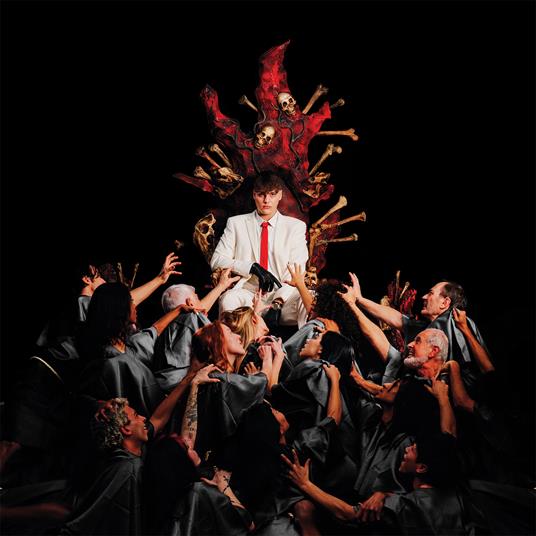
The devil, esotericism and mysticism appear in many songs on the album, where the central theme is the forms of evil: note, for example, The Antichrist, Lilith, Lucifer, Eva, Paganini and Three-Headed Goat, up to the reference to William Golding with the track The Lord of the Flies and the more political Ilva, where evil is embodied by the serious damage caused by the Taranto steelworks, which Kid Yugi has known since childhood. A theme, that of the steel industry, which led the rapper to organize numerous charitable initiatives in support of cancer research, the incidence of which in the Taranto province remains very high.
“The flowers of evil are now withered
Who walks with the lame learns that this life is made of steps
The hand on the breast of the mea culpa looks like a harakiri
We are luminaries among acids and luciferins”
(from Paganini)
Tristano e Isotta, Gilgamesh e Logos: un fumetto su Kid Yugi
His third and final album Anche gli eroi muoiono, released in January 2026, had already in a few months sold more than 150,000 copies and continues to top the charts. As of October 30 it also appeared in a deluxe version, titled Anche gli eroi muoiono (POST MORTEM), which, in addition to some unreleased tracks, is accompanied by a comic, the result of a collaboration between Sergio Bonelli Editore, Universal Music Italia and Thaurus: Logos.
Premiered exclusively at Lucca Comics 2026, the comic is set in a grim underground world — Logos, indeed — and tells of a place where every word spoken can transform reality and for this reason its inhabitants are condemned to silence. A kind of epic adventure that, through the figure of Kid Yugi, who appears as protagonist and a keen wordsmith, underscores the importance of words, voice and language.
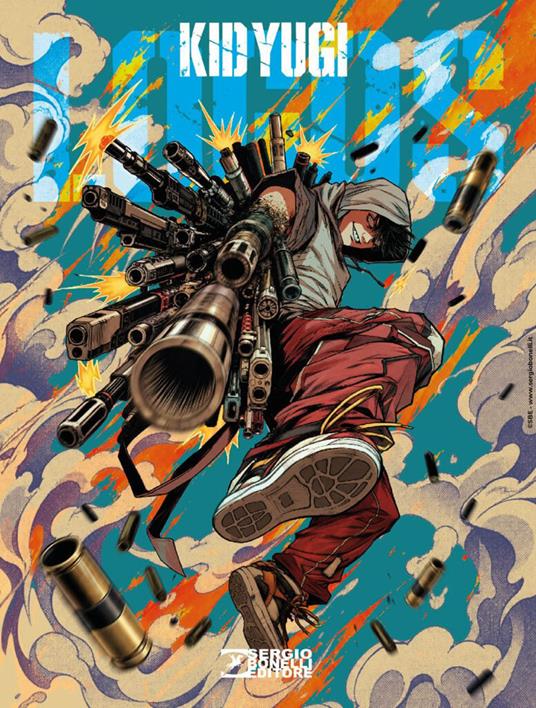
Anche in questo album non mancano i riferimenti letterari come Gilgamesh, un omaggio all’omonima epopea della Mesopotamia, e Tristano e Isotta, un brano che racconta la fine tragica di un amore impossibile, condannato alla distruzione.
“Come ti sei ridotta, il mondo ci boicotta
Solo il tuo sguardo mi ferisce e penetra la cotta
Ora sei insieme a un altro, so che l’hai fatto apposta
Il nostro amore che ci uccide alla Tristano e Isotta”
(from Tristano e Isotta)
Certo, ascoltando i brani nella loro integrità, i riferimenti alla letteratura non sono il tratto che più traspare, o perlomeno non immediatamente, dato che anzi, la maggior parte dei testi raccontano piuttosto il mondo delle droghe, episodi di disagio psicologico, dipendenze, questioni politiche legate la Sud Italia (e non solo), criminalità, dynamics relazionali tossiche e frustrazione tipicamente “giovanili” in un linguaggio schietto, anche molto scorretto, dove si menzionano anche temi delicati come il revenge porn. Una serie di tematiche più lineare rispetto all’immaginario “tradizionale” del rap. Almeno, volendo assecondare gli stereotipi.
However, the lucid and subtle parallels with literature are a truly singular trait of Kid Yugi, which, given his young age, as well as that of his audience formed mainly by Gen Z, in a few years has managed not only to stand out but to arouse curiosity about literature among his fans — mostly high school students or barely twenty-somethings.
Kid Yugi uses swear words and at times is vulgar, but between the bars he tells us about Shakespeare, Bulgakov, Dostoevsky, the Flowers of Evil, Sartre, Chekhov and the Nouvelle Vague.
His references are not necessarily explicit and clear, and sometimes one might wonder what the books he mentions have to do with the songs themselves. But that is also the beauty of music: you listen to it not to seek explanations, but to enjoy it as you would with films, paintings and all other art forms. Even when we do not know what they mean.
For this reason Kid Yugi is so liked and continues to rack up successes, right now on tour across Italy from Milan, Rome, Bari, Florence, Naples and many other cities. And for this reason not only does he surprise, but he also has something to teach us: rap can be literature. A literature that, at last, is perceived not only as a closed microcosm of a few “chosen ones,” but as something alive, tangible and rich in meaning, even to younger people.