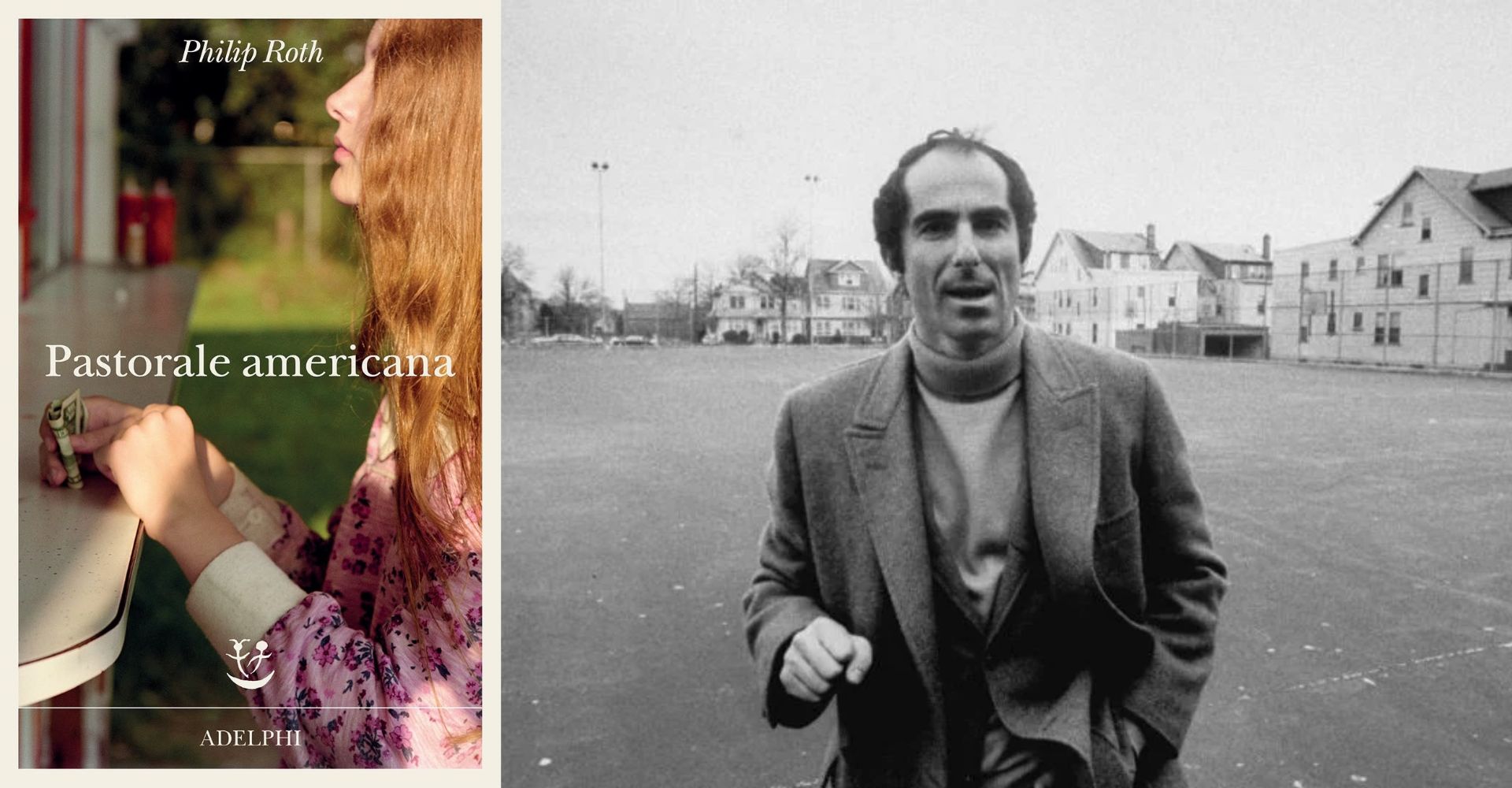
Philip Roth is a writer who sparks debate. He does so, even after his death in 2018, when people discuss his novels (and the publication rights in Italy). He does so when talking about his controversial biography by Blake Bailey, and he does so when discussing the Nobel Prize – as an example of a great author who never won the prestigious accolade.
Now, after Portnoy’s Complaint and Operation Shylock, his name returns to the bookshops as Adelphi proceeds to publish American Pastoral, long since unavailable on shelves (in the new translation by Matteo Codignola, succeeding Vincenzo Mantovani): the great novel in which Roth narrates the dream – shattered – of an American family, whose decline unfolds in parallel with that of the country as a whole.

What American Pastoral is about
Released in 1997 and winner of the Pulitzer Prize in 1998, American Pastoral reconstructs the life of Seymour Levov, nicknamed the Swede, a mythical figure described by a recurring voice in Roth’s body of work, Nathan Zuckerman. The novel begins precisely from this, from a name that feels almost like an invocation.
Because for the young Nathan (and not only), in the Newark of the war years, that slightly older, blond boy with blue eyes represents a myth, a deity. First a boy who excels in school and in sports (basketball, baseball, and football) and then a successful man, with the family business and a perfect family.
When the two men meet as adults, Nathan sees in Seymour something different, a normality and ordinariness that render him almost boring, so much so that, paraphrasing Tolstoy, he states: “As far as I knew, the life of Levov the Swede had been the simplest and most ordinary, therefore the best one can imagine – at least in America“.
And then the bomb goes off…
The entire novel could also be read as the answer to a question that Zuckerman himself poses: “What kind of mental life had driven [Seymour]? What had always threatened, or possibly threatened, the trajectory of his life?” And the answer is the reconstruction – through memories, newspaper clippings, and the account of Jerry Levov, the younger brother – of a whole existence, crushed between the moral values of the father and the radical choices of the daughter.
It is precisely in this entanglement, in the balance of three generations spanning the American decades from the 1940s to the 1990s, that the novel plays out, in which the episodes of a man’s life enlarge until they become the testimony of an America that changes, protests, falls and tries to rise again. Because the Swede, once a neighborhood myth, becomes “the innocent par excellence,” a father set against his daughter and her generation who, in the 1960s, fill streets and protest the Vietnam War, while he faces economic shifts and the consequences of a deadly attack.
“That bomb blew up his life. The real victim was him.”
Why Roth is Still Roth
When American Pastoral appeared, Michiko Kakutani (coincidentally also a Pulitzer winner in 1998, but for criticism) wrote about it in the New York Times as a tragic parable of the American innocence, the end of that dream that still today is associated with the United States.
And indeed, as noted, perfection suddenly cracks, giving way to complexity and drama, to political and social change that Roth describes without turning the entire novel into a treatise. Instead, the story remains the story of a man, of a bomb that—literally—blows lives to pieces and which, for this reason, is forgotten. As if the façade were increasingly more important than reality.
That reality which, however, readers can know only partially, since everything is filtered through Zuckerman’s gaze. And it is here that Roth’s style shines, different from his more sacrilegious books, but not for this reason restrained, where the quirks are set aside and an increasing depth of the main characters’ psychology appears.
It is a Roth who works by subtraction, and this may seem paradoxical. American Pastoral runs to over 470 pages, but it is behind the many details that American society and the work’s meaning truly hide, it is behind references to children’s books and moments of sport that Seymour appears as a defenseless figure…
Not surprisingly, then, that after such a strong opening, with the utterance of that name that for the Swede’s fellow citizens was a magical formula, American Pastoral ends with a doubt: “What in the Levovs’ life was less execrable?”
A novel that speaks to today?
Within American Pastoral some themes stand out more than others, themes that, without too much fear of contradiction, can still be defined as timely: the generational conflict, the miscommunication between fathers and sons (and daughters), the radicalization, and the decline of an industrial America in the face of countries where labor is cheaper. Yet equally relevant are a certain “guilty innocence” of America (as Roberto Saviano also remarked on Che Tempo Che Fa) and a dream that, mutatis mutandis, can no longer captivate new generations.
GALLERY OF LIBRARY EVENTS – What’s wrong with doing everything right? asks the Swede, the man who had everything… On the occasion of the release of the new edition of American Pastoral, on November 10 Adelphi presents “A Day with Philip Roth.” The Pulitzer-winning novel will headline 15 events from North to South, in the Feltrinelli bookstores of Arezzo (with Gabriele Grazi), Bologna (with Elena Lamberti and Paolo Viganò), Brescia (with Michele Masneri), Florence (with Vanni Santoni, Alessandro Raveggi and Matilde Santoni), Mantua (with Georgiana Ursache and Tasty Tales Club), Milan (with Ilenia Zodiaco and Marco Cantoni), Palermo (with Giorgia Duro and the bookclub Righe Ribelli), Pistoia (with Matteo Moca), Rome (with Antonella Lattanzi and Tommaso Pincio), Salerno, Savona, Turin, Trento (with Daniele Giglioli and Andrea Binelli), Varese (with Giulio D’Antona) and Venice (with Giorgiomaria Cornelio), among reading groups, readings, and special events.
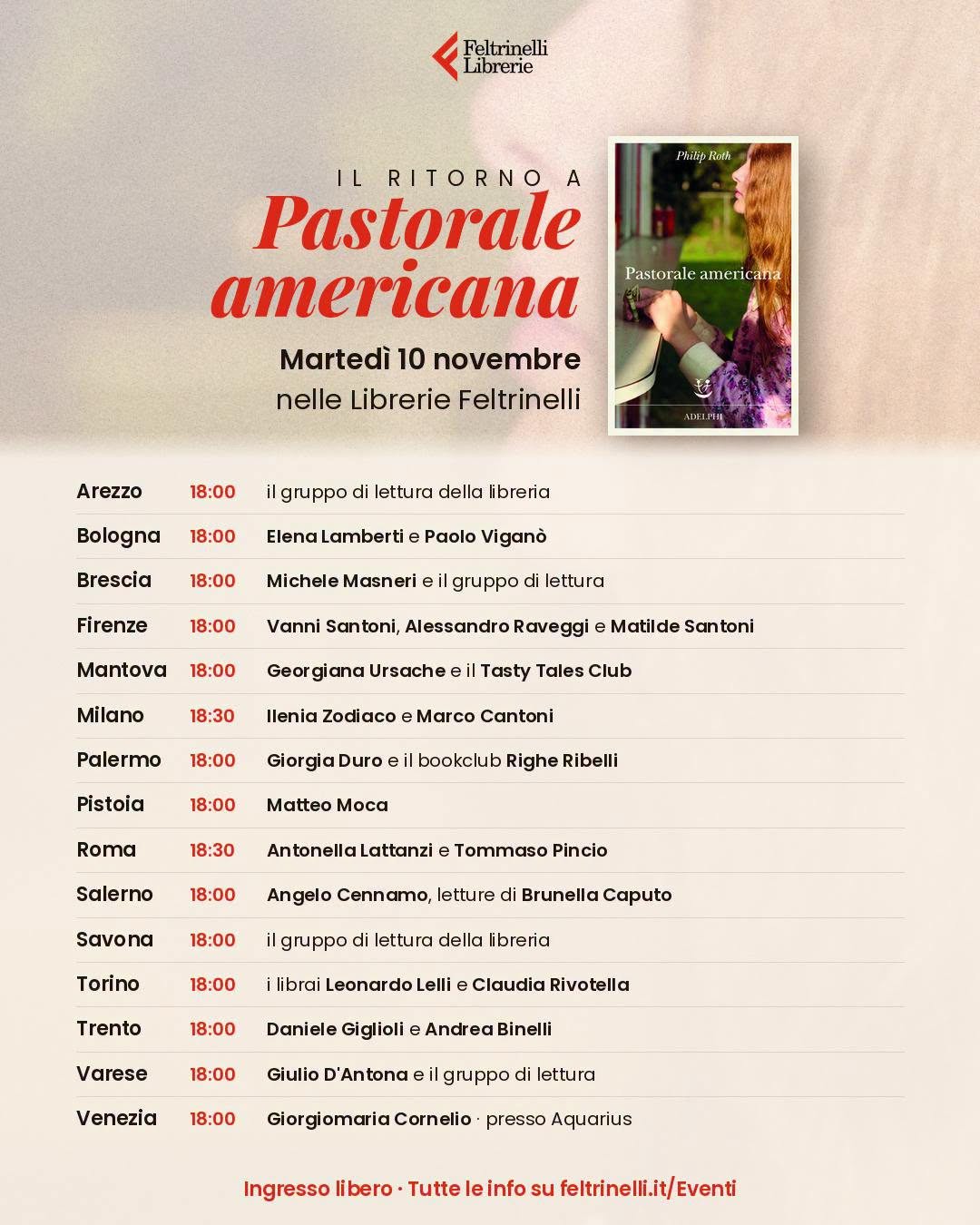
Gli appuntamenti non riguarderanno solo le librerie Feltrinelli. Domenica 8 novembre pomeriggio Pastorale americana sarà protagonista al Libraccio Naviglio Alzaia Grande di Milano (con Orazio Labbate), giovedì 12 novembre alla Ubik di Messina (con Francesco Musolino), domenica 15 novembre alla libreria Spazio Sette di Roma (con Emanuele Trevi e Annalena Benini), e altri incontri sono in via di definizione.