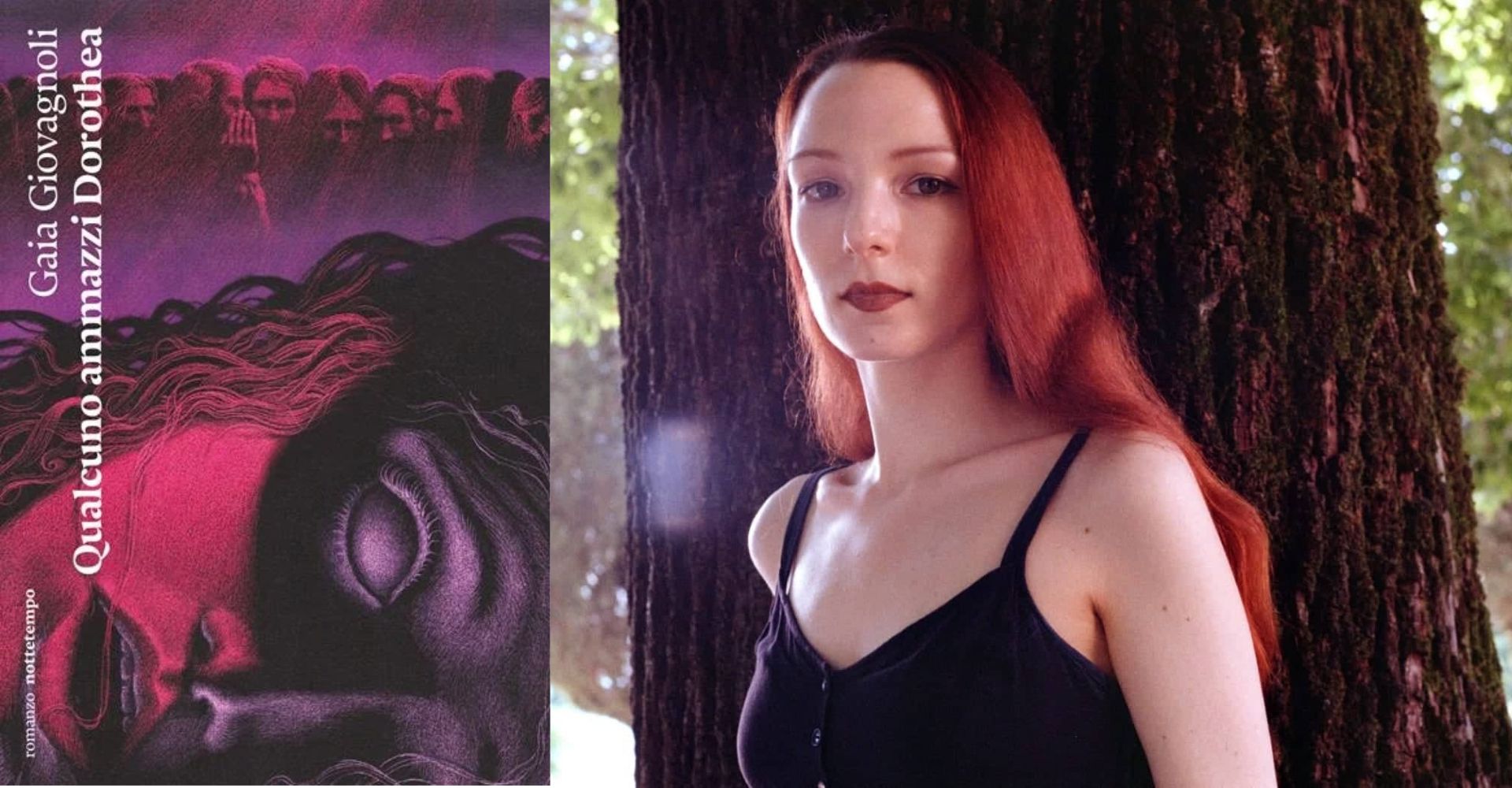
Being fourteen in 1986, living in a small town like Santarcangelo di Romagna and facing the first stirrings of adolescence can be complex enough on its own.
Even more so if one discovers that, by experiencing intense pleasure or carnal pain, one can “leave” oneself for a few minutes, welcoming into one’s body the consciousness of a deceased tied to one’s sexual partner.
Esthetic necromancy, that’s what they call it: a skill that in 1999 Dorothea D’Amico will claim to have possessed since she was indeed a girl, and that would have allowed her to discover that the wealthy and suave Rolando Marconi took the life of a young prostitute…
Door to Door with the Mystery
[17:33] @Prof_Limbooze: In Haiti the dance that leads to trance is often accompanied by gestures of a sexual nature. Some say there are orgasms similar in Moroccan rites where the spirit of Āʾisha Qandīsha (Lalla Aisha) possesses people.
[17:33] @Roibois66: It seems to me that many conversations are wasted, have patience
[17:36] @Prof_Limbooze: @Roibois66 @Rinomina_00 And it seems to me you just want someone to stone.

The well-to-do husband of the “respectable” Torino, however, denies anything and discredits the slut with whom, until then, he had been so greedy for confidences and provocations.
And it is from here that Qualcuno ammazzi Dorothea (overnight) by Gaia Giovagnoli takes off, a work of fiction that blends a fascination with the sovrannaturale with a critique of voyeurismo mediatico, in which the unusual accusation of murder against the heroine becomes a fungal bed where for years TV interviews, newspaper clippings, discussions on online forums, statistics, letters, podcasts and eyewitness testimonies proliferate.
All of it to shape the 4.0 model of a new villa in Cogne, built around a single question: Was Dorothea right or was she merely a driven upstart possessed?
Qualcuno ammazzi Dorothea, o per lo meno le sue visioni
I believe a lion is a lion, and you should not be surprised if it devours you. Especially if you think you can hug it. Especially if you still carry the smell of blood.

Giovagnoli alternates fragments of these materials with a long, sensory-rich flashback that sheds light on the puberty phase when Dorothea’s charm had catalyzed the excitement and the envy of her peers.
A period marked mainly by the honey-and-bile relationship with her father, a former policeman unable to accept that his daughter could have inherited the “hallucinations” of her mother, who had committed suicide years earlier, and who would go to any length to keep her on this side of his lurid tendencies toward debauchery.
As a consequence, even then the mediatic power of the protagonist had shifted from being a “gift of God,” as the etymology of Dorothea’s name suggested, to a plague that would expose her to every sort of cruelty.
Detachment as phàrmakon
ROLANDO MARCONI: He is intelligent and cultured. He can speak very well.
JOURNALIST: So he acts.
RM: I think so. Definitely.
Nevertheless, it would be a mistake to consider the protagonist as merely the succubus of a misogynistic bigotry, just as reducing her to the role of scapegoat would ignore the enterprising spirit and the pride that distinguish her from beginning to end.
It is she who always assesses how to present herself, she who carefully selects or discards clothes, words and interlocutors, and it will not be long before it is she who decides to lock away for years every inch of her heart, barricading herself behind a row of candles, Indian statuettes and strict rules in the apartment where a dead man will “wear” her every time a living man pays to prostitute her.
But what is more likely to happen, when a character seductive, uncomfortable and icy like her continues to enjoy an unusually exuberant presence that makes everyone eager to belittle or control her?
Qualcuno ammazzi Dorothea, con la parola o con la spada
DOROTHEA: If he had really been there, and had lived everything I’ve lived, from the moment I was born to now, and had seen it, he would understand why I’m speaking to her here. He would not doubt that it’s the truth. But he cannot understand.
JOURNALIST: Have patience, Dorothea… but who can understand her?
When Dorothea unbuttons herself for the second time in her life, denouncing Marconi in an attempt to avenge what she imagines to be yet another victim of a merciless patriarchy, the response does not delay.
A web of public and private manipulations returns to feed on her identity, denying her authority and trust and not putting her in a position to speak properly about herself.
That is why, if the construction of the text already recalled the Linès-Fellow Argument of Jean-Marc Aubert and The killer is among the lines by Janice Hallett, one soon asks whether the fate of the protagonist, in turn, might instead echo the fate of Carrie by Stephen King.
“And do not cast your pearls before swine”
[…] ghosts do not exist, okay? Real life is this one and only this, and the rest are just dreams and nonsense.
Giovagnoli, however, is more the daughter of Angela Carter than of the king of horror, and she is keen to probe the relationship between eros and thanatos, between sex and power and between mysticism and free will, more than the vengeance of a subject who oscillates between metamorphosis and coercive domination.
This explains why Dorothea pays less attention to her tormentors of the moment than to the specters she contacts: it is to them and only to them that she yields everything and to whom she yields herself completely, not because they are more harmless than the people she deals with, but because with them she touches peaks of intensity and emotional reciprocity that are barred to her in the world.
Of course, seeking empathy by turning to spirituality, true or imagined as it may be, remains dangerous, as we will see—but if anything, from time to time, it will allow Dorothea to surrender to a state of grace that many other women do not have a protected channel to experience.
The intimacy that does not fall into possession, the co-penetration that goes beyond the act of penetration. And the lucid tenderness with which we consent to look at someone, letting them reveal to us every one of their most uncomfortable truths, without daring to replace even the shadow of another voice in the chapter.