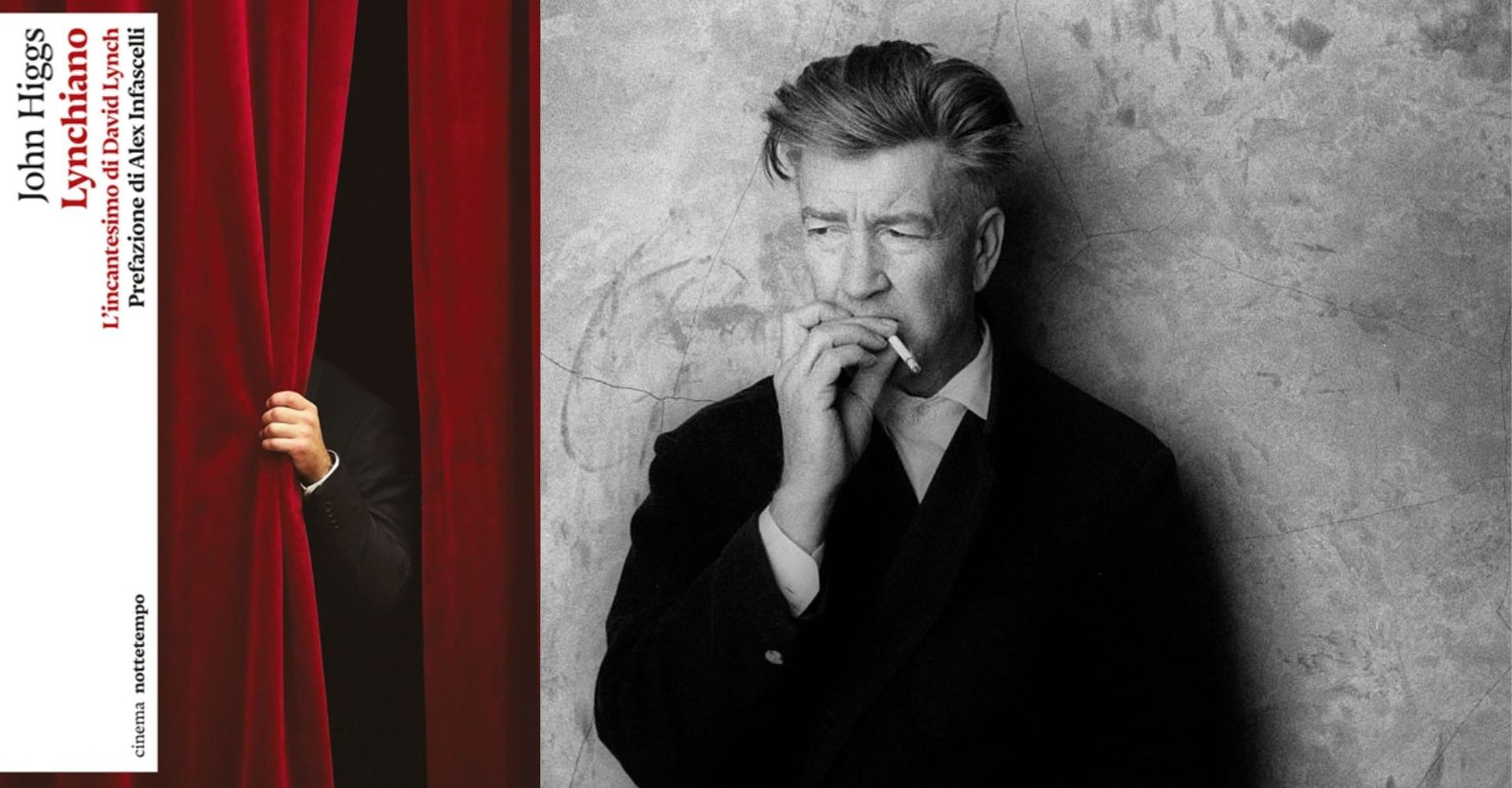
“No one, apart from David Lynch, has ever truly been Lynchian.” With the paradoxical and illuminating logic of a koan, John Higgs places in the reader’s hands, from the very first pages, the key to his book. Or rather: the key that leaves the door ajar, because some thresholds are crossed only if you do not fling them wide open.
Lynchian – The Enchantment of David Lynch (nottetempo, translated by Stefano Piri, foreword by Alex Infascelli) opens with an image that anyone who has loved the director of Missoula will recognize as both tender and poignant: the spontaneous shrine that arose in January 2025 around the Bob’s Big Boy mascot in Burbank, the diner where Lynch for years ordered every afternoon a chocolate milkshake and a cup of coffee. Donuts, cigarettes, owls, photographs of Laura Palmer, blue roses (which in nature, as every fan knows, do not exist). We do not erect altars to directors. We erect them to icons, to Bowie, to Diana. Or to those who have changed our lives.
What exactly did David Lynch do?

From here the question that anchors the entire volume: what exactly did David Lynch do? And why, when other authors handle the same instruments (red curtains, flickering lights, figures speaking in reverse), does the enchantment not come to be?
Higgs chooses the humbler path, and for this reason the more effective one. He relinquishes exegesis and becomes a narrator, a compiler of anecdotes, so much so that Infascelli describes the book as “an audiovisual document described in writing.”
We begin in Boise, Idaho: the father, a forest researcher studying tree diseases, the boy who learns early that beneath the toughest bark there thrums an unending dance of growth and decay. Then the night on Shoshone Avenue, when from the dark emerges a naked woman, with a bloodied mouth, “something otherworldly” that the young David longs to help, though he does not know how. This is the primary revelation: the dark can come to light, and every time it happens it is steeped in mystery. Dorothy Vallens on Lumberton’s lawn, Ronette Pulaski on the railroad bridge are but his reincarnations.
“David, I don’t think you should ever have children.”
Then Philadelphia, “my greatest influence,” the dense fear in the air, the Art Life learned from Robert Henri: coffee, cigarettes, painting. And a scene that would be worth the book on its own: the father visiting the basement of the “experiments,” among dead birds and rotting fruit, and the verdict in the car on the way to the airport: “David, I don’t think you should ever have children.” The fiancée, meanwhile, was already pregnant. Higgs observes with nuance that Lynch’s pain did not arise from paternal worry but from his own blindness. “How can I show others the beauty I see?” The wind that, in 1967, crosses one of his canvases, asking to move and to sound, is the answer.
Cinema, for Lynch, was never an end. It was a vehicle.
It is through meditation that the essay reveals its most precious honesty
The book’s frankest honesty comes through its meditation section. Higgs dismantles the equation, as widespread as it is lazy, that practice explains the style: Lynch was already fully Lynchian before 1973, and many meditate without ever making Eraserhead. He even compares meditation to brushing one’s teeth, a light but salutary daily cleansing. Those who, like me, have spent a life pursuing inner inquiry by a path different from his may smile at the reduction, yet recognize its sobriety: it is the antidote to the holy relic. And yet Higgs shows how meditation has transfigured the theology of the work. The chronic anger dissolved, the Eraserhead script that would close with Henry devoured by the baby, instead opens to the Woman in the Radiator, to the embrace in the white light. From there, a constellation of grace descends: the Angel in Fire Walk with Me, the Good Witch of Wild at Heart, the robins of Blue Velvet. “The more darkness you can gather, the more light you can also see.”
The evil, for Lynch, is only the surface
Evil, for Lynch, is only the surface; deeper down, existence is a grand unifying love. It’s no accident that Cooper’s words to the dying Leland conjure an intellect “unblemished and naked,” a transparent space “without a boundary and without a center” (clear echo of the Bardo Thödol).
Also memorable is the comparison with George Lucas, who in 1981 offered him Return of the Jedi: Lynch arrived at Skywalker Ranch with a headache, left with a migraine, and refused. Two visionaries of the same generation, Higgs notes, but oriented toward opposite destinies. Lucas projected his vision outward and changed Hollywood; Lynch dug inward and changed only the inner life of viewers. Which is to say: everything.
The book’s theoretical core, however, lies in its penultimate chapter. Most directors rely on mirror neurons: showing an emotion to induce it, with a technique not far from advertising. Lynch does the opposite. He slows down, pauses, throws sand into the gears of narration, and leads the viewer into a state approaching meditative awareness, where emotion arises authentically, not prescribed. “Films are like six,” he wrote. Here is the ultimate sense of the initial koan: Lynchian is not a repertoire of motifs, it is a state of consciousness. And the term finds its meaning to the extent that we, the audience, become Lynchian.
The book never slides into hagiography
Higgs never slides into hagiography. He devotes a whole chapter to the master’s blind spots, from mostly white casts to the signature for Polanski later renounced. And he preserves intact the deepest wound of Lynch’s career: the forced revelation of Laura Palmer’s killer. “That mystery was sacred and upheld all the others,” Lynch confesses in A Slice of Lynch. “It was the tree, and all the others were its branches.” Chi mi legge knows that for years I have seen in Laura the Sophia Gnostica, the Shekinah exiled in matter, whose journey from the katabasis of Fire Walk with Me to the nostos of The Return sketches a true initiatory rite. Higgs does not walk this path, but he prepares the ground, reminding us that for Lynch “mystery is positive and confusion negative.”
And then the farewell. Lynch agrees to play John Ford in The Fabelmans in exchange for a bag of Cheetos. He enters on screen with an eyepatch and lipstick, lights a cigarette with his diagnosed emphysema, and teaches young Spielberg the horizon’s lesson: up or down is interesting; at the center is “boring to death.” “Good luck, and now get out of my office.” The camera, obedient, adjusts the frame. Then the final close-up: Lynch removes the cigar, smiles, says “It’s been a pleasure.”
And then he left. Silence.
No one, aside from him, has ever truly been Lynchian. But those who accompany Higgs’s book and later return to lose themselves in his films begin to suspect that the koan holds a promise.
The mystery lives. Laura Palmer lives. David Lynch lives.