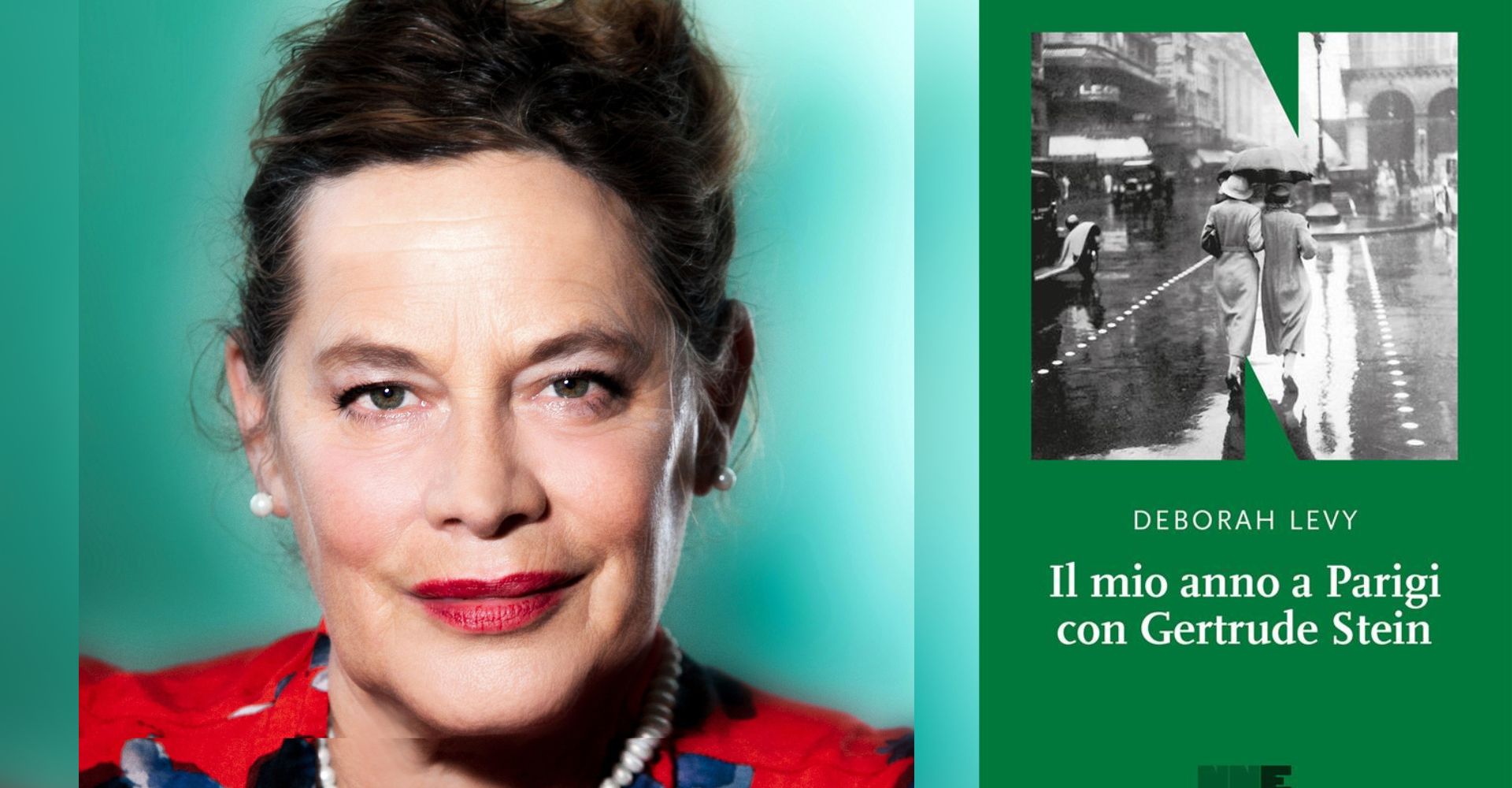
On the opening page of My Year in Paris with Gertrude Stein by Deborah Levy (NN, translated by Gioia Guerzoni), a cat disappears.
The cat is named Lui, but in the original English its name is “it”, a pronoun that can denote anything and which, in the expression “lost it”, also means having lost one’s head, one’s grip, something of oneself. The cat belongs to Eva, one of the narrator’s two new friends, but its disappearance ends up involving all three women, becoming one of the many concerns that divert Deborah Levy from her real purpose: to write an essay about Gertrude Stein.
And yet, upon closer inspection, that loss has a lot to do with what Levy is seeking. Because one of the questions that runs through the book is precisely this: what must we lose to become modern?
A Highly Personal Narrative Form

Chi conosce Deborah Levy sa che difficilmente le sue storie procedono in linea retta.
In her novels, as in her autobiographical works, the British writer has accustomed us to a highly personal narrative form, capable of moving naturally from the everyday to philosophical reflection, from irony to introspection, turning objects, conversations and small incidents into opportunities to question much larger issues.
Also this time Levy seems to want to tell a story and, at the same time, continually shield herself from its development.
The result is a book that blends novel, essay, biography and autobiography, and in which the figure of Gertrude Stein becomes the mobile center of a constellation of encounters, memories, readings and associations.
Something That Seems to Always Slip Away
We are in Paris, where the narrator spends a period in the company of Eva and Fanny.
The first is a graphic-novel illustrator, married to a man who lives in Seattle and whom she now meets mostly through a screen; the second works in finance, has three lovers and a lively love life, behind which lies the wound of a difficult relationship with her father.
The narrator, older and solitary, meanwhile tries to write about Stein, but her days are continually interrupted by her friends’ happenings, by their conversations and by her own fantasies. The three women watch one another, misunderstand one another, seek one another, while something in their lives seems to slip away continually.
The plot, to be fair, is almost nonexistent, and Gertrude Stein herself seems to recede into the background at times compared to the events of the three friends. “Gertrude Stein knew Matisse, Picasso and Braque, but what interests me more are Fanny and Eva,” confesses the narrator. Levy does not intend to write a traditional biography of Stein, nor to reconstruct in an orderly fashion the history of the Parisian avant-gardes. What she is interested in is understanding what the American writer’s experience can still tell us, what questions about freedom, identity and language it continues to pose to our present.
A Life Beyond Conventions
When Gertrude Stein arrived in Paris in 1903, she was twenty-nine and the desire to build a life different from the one prescribed by the conventions of her time drove her. She was a cultivated, ambitious, homosexual woman, little inclined to adapt to the dominant models of femininity.
In the Rue de Fleurus apartment, initially shared with her brother Leo, she began collecting works by avant-garde artists such as Picasso and Matisse and to experiment with a writing that broke with the canons of nineteenth-century literature. In Paris she met Alice B. Toklas, who would become her lifelong partner.
But becoming herself meant also giving up something. Stein had to free herself from her brother’s authority, who despised her literary experiments, and above all from an image of femininity with which she could not identify.
Levy tells this emancipation through the corset, emblem of a female body forced to take a predefined shape. Stein abandoned it, along with the constraints it epitomized. Her modernity was therefore both an artistic achievement and, prior to that, an existential one: to invent a new language, she had to grant herself the right to live a new life.
“Naturally, One Is Never Oneself”
“Naturally, one is never oneself,” Stein wrote in The Autobiography of All. It is a line Levy returns to, asking whether modernity may consist precisely in the impossibility of possessing a definite identity. To become modern would then mean accepting that we are continually in transformation, renouncing a fixed idea of coherence, and learning to assemble the different parts of oneself without trying to reduce them to a single form.
The question also concerns writing.
Stein had studied psychology with William James, whose conception of consciousness as a continuous flow of thoughts and perceptions would influence her literary research. At the same time, the Cubist revolution offered her the possibility of imagining a representation of the world no longer subordinate to a single point of view.
From these experiences arose a literary experimentation founded on repetition, on the deconstruction of syntax, on seeking unexpected connections between words. In the poetic collection Tender Buttons everyday objects are stripped of their usual meanings and recomposed through language. Perhaps it is no accident that Levy is especially drawn to this book: even in her own writing objects often become starting points for unforeseen associations, small portals capable of opening up other stories and meanings.
For Stein, as for the artists she frequented, being modern meant seeing something others had not yet learned to see, and to do so one had to question the forms through which reality had been told until then. “Every century,” Levy writes in what reads like a statement of poetics, “needs an artist who dismantles the coherence that has been instilled in us and makes room for something new.”
Stein Remains an Elusive Figure
And yet Stein remains an elusive figure, even for those who, like Levy, deeply admire her audacity. The narrator does not hide the fatigue of reading her, the irritation provoked by her repetitions, the sense of never quite reaching the center of her writing, of her “it.” It is as if Stein wished to be understood and at the same time strove to make any definitive understanding impossible. Perhaps it is precisely this refusal to be explained, even more than her linguistic innovations, that fascinates Levy.
In her book, Deborah Levy follows a line of thought, then abandons it for a seemingly secondary detail, which becomes the starting point for another story. A single image is enough to open a passage between distant eras, or a tiny episode to restore a character.
These juxtapositions, sometimes surprising, sometimes openly comic,
are among the most successful aspects
: Levy acrosses modernism as a network of relationships, in which artists influence each other, meet, contradict one another, and where even those who have never met (such as Stein and Freud) seem to be able to engage in dialogue.
A Logic That Resembles Dream Logic
My Year in Paris with Gertrude Stein preserves, at least in appearance, many elements of realist fiction: the characters are recognizable, their lives are told through everyday situations, objects and places are described with precision. But realism concerns the matter of the tale more than the way it is organized.
Levy proceeds by associations, overlays, abrupt shifts in perspective, following a logic that resembles dream logic more than traditional narration.
Even the repetitions have a specific function. Words, images and situations recur in different contexts, each time changing their meaning. The missing cat, the absences, the desires, the things lost end up composing a lexicon that gradually becomes familiar to the reader. It is as if Levy builds with us, as in Autobiography in Movement, a relationship akin to the one that binds the three friends, made of allusions and shared references, of words that acquire a special meaning precisely because they have already been spoken.
The difference is that, while Stein pushed experimentation to the point of undermining the very comprehensibility of the text, Levy retains a lightness and clarity that make the reading surprisingly pleasant. She does not seek to imitate the radical formalism of the American writer, but to find a personal way to gather her legacy.
The questions running through Stein’s life return in the stories of Eva, Fanny and the narrator: how does one build a life that resembles us, while retreating from others’ expectations? None of the three women has an answer, and perhaps it is precisely this uncertainty that makes them interesting. Even their friendship, with its misunderstandings and sudden complicities, becomes a space in which to experiment with different forms of closeness and freedom.