
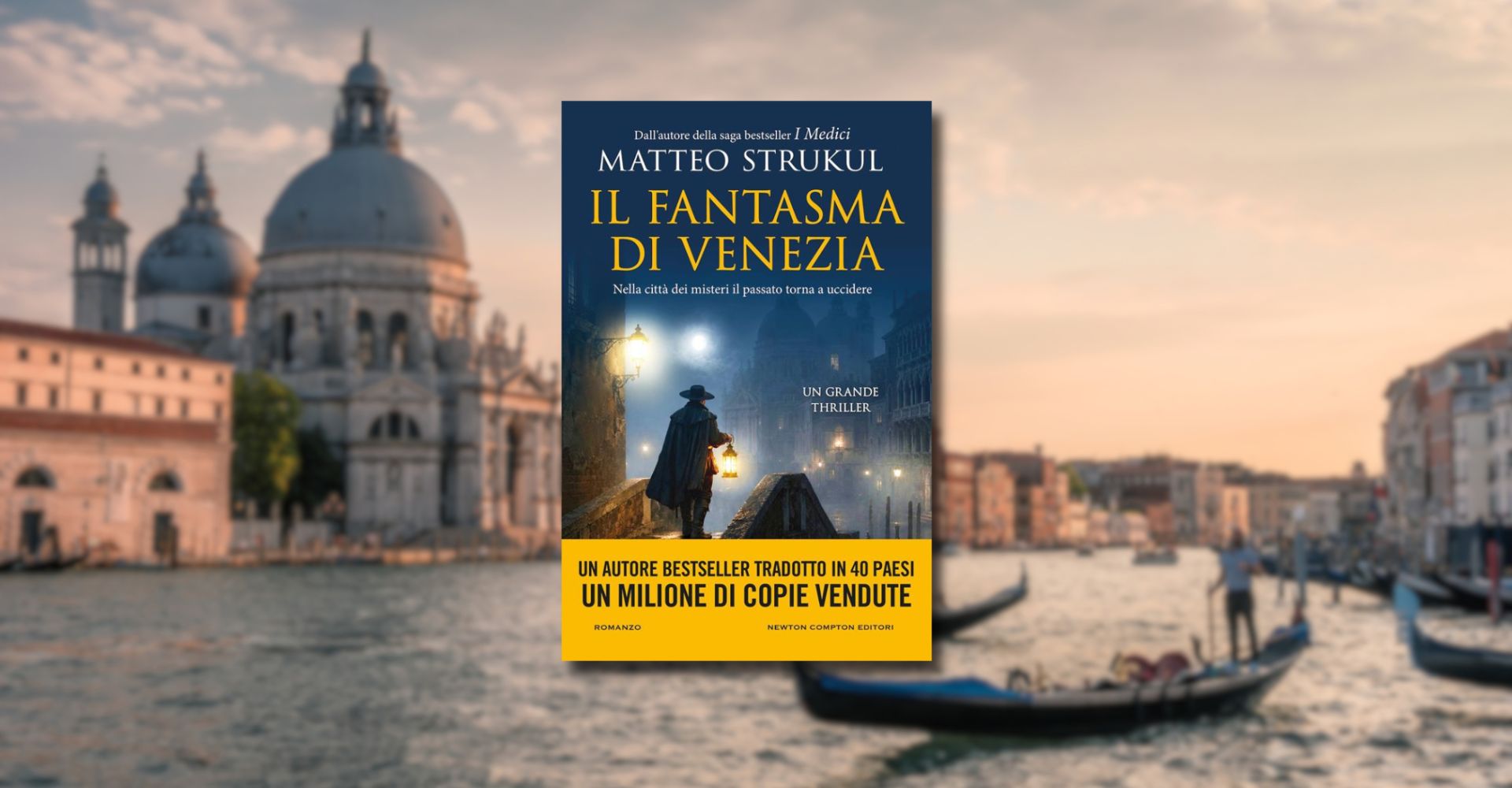
The Romantic Novelism of Matteo Strukul
Always, I have chosen the nineteenth-century novel, or that of the early twentieth century, as a reference canon for my writing and never as much as in the trilogy that began with The Conspiracy of the Vipers, continued with The Revenge of the Lions of Venice and now concluded with The Ghost of Venice, this assertion has proven its truth more than ever.
The Hunchback of Notre-Dame by Victor Hugo, The Count of Monte Cristo by Alexandre Dumas, Lost Illusions by Honoré de Balzac and The Phantom of the Opera by Gaston Leroux, just to name a few examples, are true sources of inspiration for The Ghost of Venice and the two novels that precede it.
One can think of the grim vendetta that characterizes Dumas’s novel, the disguises of Edmond Dantès, the envy that consumes Fernand Mondego and Gaspard Caderousse, or instead the beauty of Esmeralda, capable of making the inquisitor Frollo and the poet Gringoire fall in love in The Hunchback of Notre-Dame, or even the scarred visage of Erik in Leroux’s famous novel; and one will find parallels with the scars and the mask of Caigo, the antihero of my trilogy, which is all dominated, moreover, by the desire for revenge, by passion and by a thirst for power, and which features as well beautiful, fierce, and independent women such as the painter Chiara Varotari or Rea, the young Greek-born perfumer.
The point is that, always, my aim has been to write stories that smell of literary classicism, romance as a form of the extraordinary, meaning something adventurous, captivating, in short a literature that diverges as much as possible from contemporary everyday life, a theme that does not interest me at all, and that instead embraces the historical, the picaresque, the daring, the roccambolesco as in The Charterhouse of Parma by Stendhal or in The Captain’s Daughter by Aleksandr Pushkin.
It is a demodé literature that still feeds on plots, intrigues, passions, mores, swords and poisons, but that remains alive and vibrant if it is true that all the authors named in this brief reflection are still here to speak to today’s generations, making readers dream, granting them escapes of love and pursuits, revelations and shady ambushes, capable of seducing and fascinating, cultivating a dimension of History and Feeling that has few terms of comparison.
Think of The Queen Margot by Dumas, with the Saint Bartholomew’s Day Massacre, the moral dilemma of the religious war, the bloody calculations of the crown of France that tries to survive itself. Is there perhaps something more romantic and timely? Or Gertrude in The Betrothed by Alessandro Manzoni who in her eyes holds a world of pain and ruin, or perhaps the fearless courage of Angelo Pardi, a romantic soldier and perpetual fugitive in The Horseman on the Roof by Jean Giono: these are unforgettable, cursed figures, able to step off the page, just as Paris and its cathedral or the Opera House know how to do.
Here come the places! Venice features in my novels as Paris does in Hugo and Dumas, it is not merely a geographic or physical setting but a world more than a novel in itself, with its sparkling canals, palazzos with sumptuous façades, narrow and dark alleys barely lit by torches, not to mention its lagoon, the forgotten islands or those destined for the lazaretto for plague-stricken patients.
For this reason I am infinitely grateful to my publisher Newton Compton: because they have always allowed me the freedom to explore this dimension so peculiar to literature, steadfastly supporting a choice aimed at valorising Italian History, Art and Culture, always with the precise intent of instructing and entertaining the reader. My stories have exactly this aim: to turn the pages, teaching something good. To be so engaging as to bring them to a close within forty-eight hours, so that reading is always understood as pleasure rather than duty or toil. Just as it is a pleasure to return to the pages of The Scarlet Letter by Nathaniel Hawthorne, Wuthering Heights by Emily Brontë, or Frankenstein by Mary Shelley.
It is to this literature that I look, and The Ghost of Venice, in the end, is for all those readers who love this kind of stories.

The Ghost of Venice
The Revenge of the Lions of Venice
The Conspiracy of the Vipers
The Crypt of Venice
The Seven Ravens
Three Unusual Crimes
The Venice Cemetery
The Seven Dynasties – The Crown of Power
Paolo and Francesca. A Novel of Love
The Medici. A Dynasty in Power
The Medici. A Man in Power
The Medici. A Queen in Power
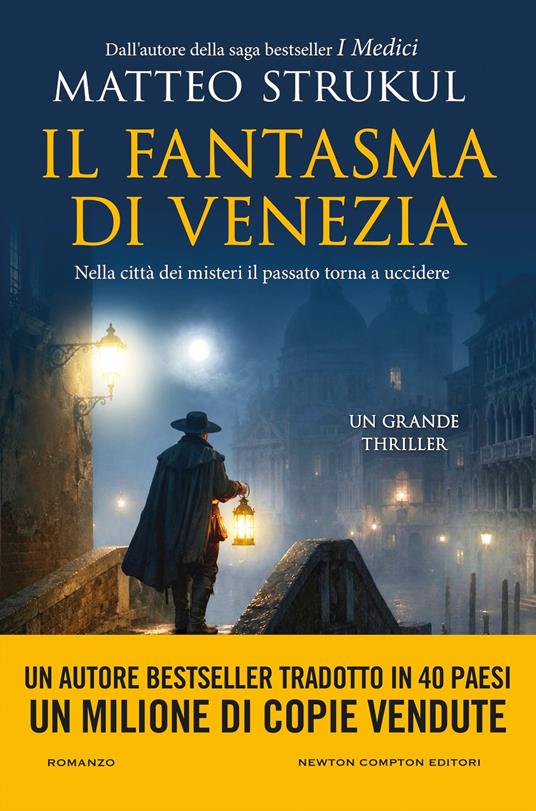
THE AUTHOR AND THE NEW NOVEL – A law graduate and member of the Historical Novel Society, Matteo Strukul is among the most acclaimed Italian writers of historical thrillers, and is translated in about 40 countries abroad.
Born in ’73, he is the author of the saga on the Medici and with the volume A Dynasty in Power (Newton Compton) he received the Bancarella Prize in 2017. Among his numerous other novels we recall Michelangelo’s Inquisition, The Seven Dynasties, The Crown of Power, Dante’s Enigma, The Venice Cemetery, The Bridge of Crimes of Venice, Three Unusual Crimes, The Crypt of Venice and The Seven Ravens.
After the success of The Conspiracy of the Vipers and of The Revenge of the Lions of Venice, Strukul leads readers to a Venice struck by plague. The Ghost of Venice, indeed, is set in 1630, when the disease lays the city low and a mysterious murderer seems bent on avenging recent political maneuvers. It falls to Marco Valier, head of the detectives and the zaffi, and to El Caigo to discover who lies behind those macabre murders, while the perfumer Rea puts her knowledge to use to counter the epidemic…
