
At the Frankfurter Buchmesse, the year’s premier gathering for the world of publishing, there was room for data on the book market in Italy for 2026. In Frankfurt, the State of the Publishing Industry Report, prepared by the study office of the Italian Publishers Association, was presented on the occasion of the opening of Spazio Italia, the Italian collective stand organized by ICE Agency in collaboration with AIE.
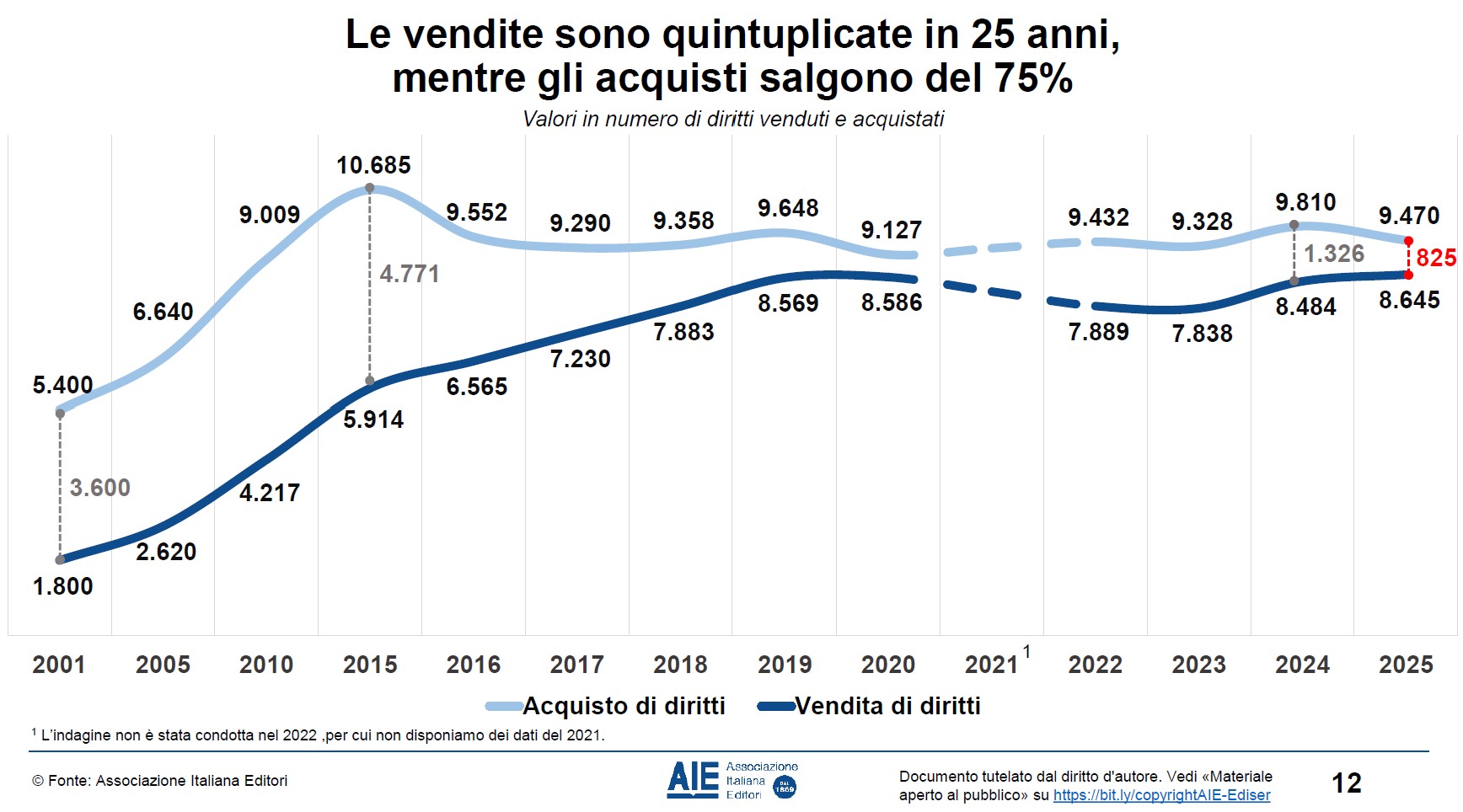
There was, of course, talk of the record sales of translation rights for Italian books abroad in 2025, with 8,645 contracts signed. At the same time, there was discussion of bookstore sales: in the first nine months of 2026 the trade market has restarted (print fiction and non-fiction sold in physical bookstores and online and in supermarkets), with value sales rising by 3.2%, thanks to public demand for books driven by the 60 million euro library bonus.

In the fair (where this year Italian exhibitors – publishing groups, independent publishers, literary agents – number 134, of which 66 are present at Spazio Italia) spoke Massimo Darchini, Consul General of Italy in Frankfurt, Ferdinando Fiore, Director of the Berlin Office of ICE – Agency, and Innocenzo Cipolletta, president of AIE.
“Since 2001 translation rights sold have quintupled”
Let’s look at the numbers in detail.
In 2025, as anticipated, 8,645 contracts for the sale of translation rights of Italian books abroad were signed, a figure never reached since AIE began collecting data in 2001. In 2025 the languages into which Italian books were translated numbered 45, and the countries reached were 64.
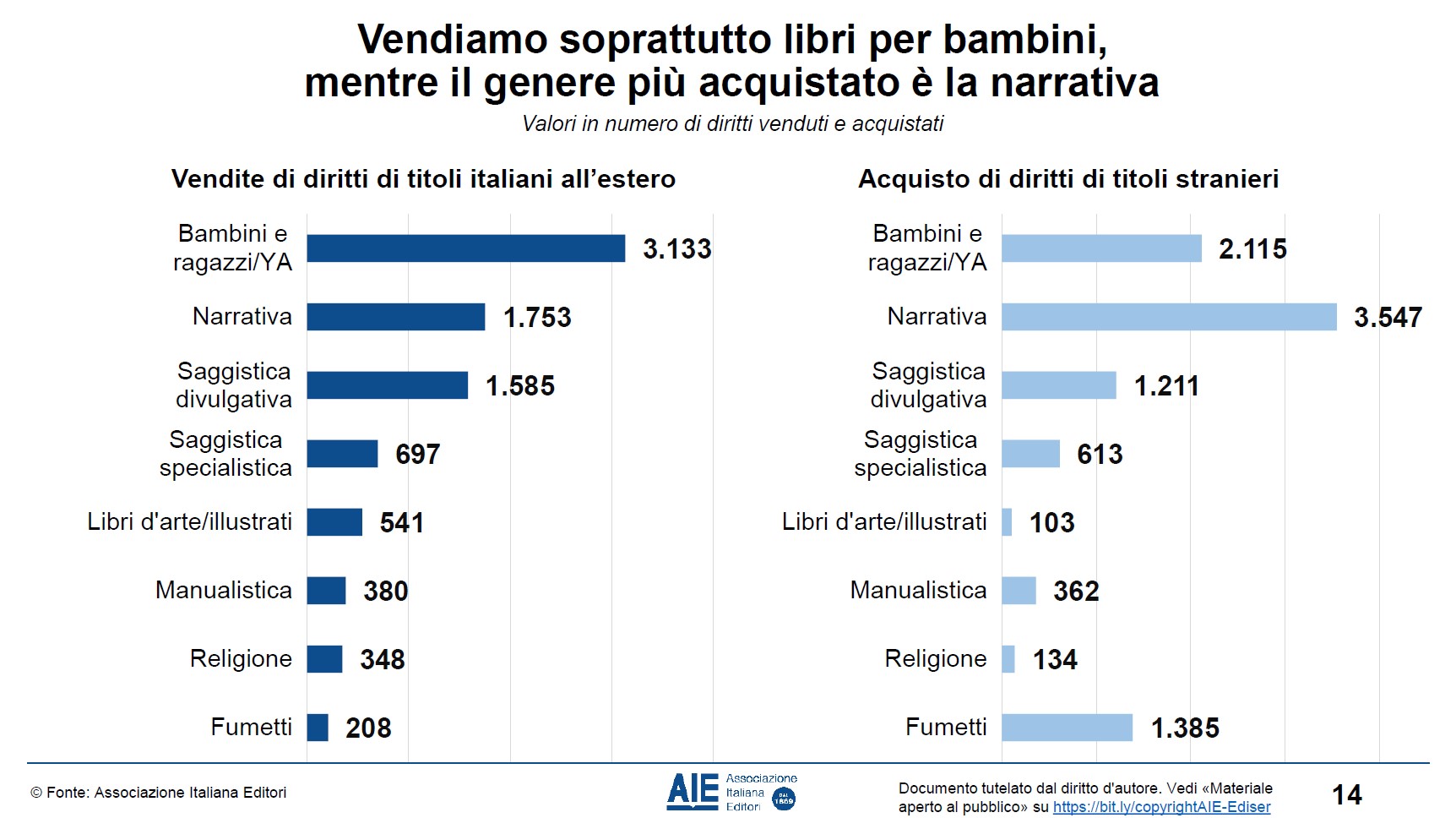
In the twelve months, in particular, foreign sales were mainly titles for children and young people (3,133), followed by fiction (1,753), general non-fiction (1,585), specialized non-fiction (697), illustrated books (541), practical manuals and self-help (380), religious books (348), and comics (208). Europe remains the main export market, with 5,401 titles sold, followed by Asia with 1,088.
“The record in the internationalization of Italian publishing is a result that makes us proud and that goes back a long way,” explained Innocenzo Cipolletta, president of AIE: “since 2001 translation rights sold have quintupled, thanks to the work of publishing houses, but also thanks to a strong institutional support network that binds the Ministry of Foreign Affairs and International Cooperation with the Italian Cultural Institutes and ICE Agency, the Ministry of Culture with the Center for the Book and Reading and with whom we are proud to collaborate. Our country allocates 1.5 million euros per year to support translations and it was the Guest of Honor here in Frankfurt in 2024, in 2025 it was Taipei, Lima and Thessaloniki, and in less than two months it will be in Guadalajara, Mexico. The effort to give visibility to all Italian publishing, including the smaller players, is yielding good results.”
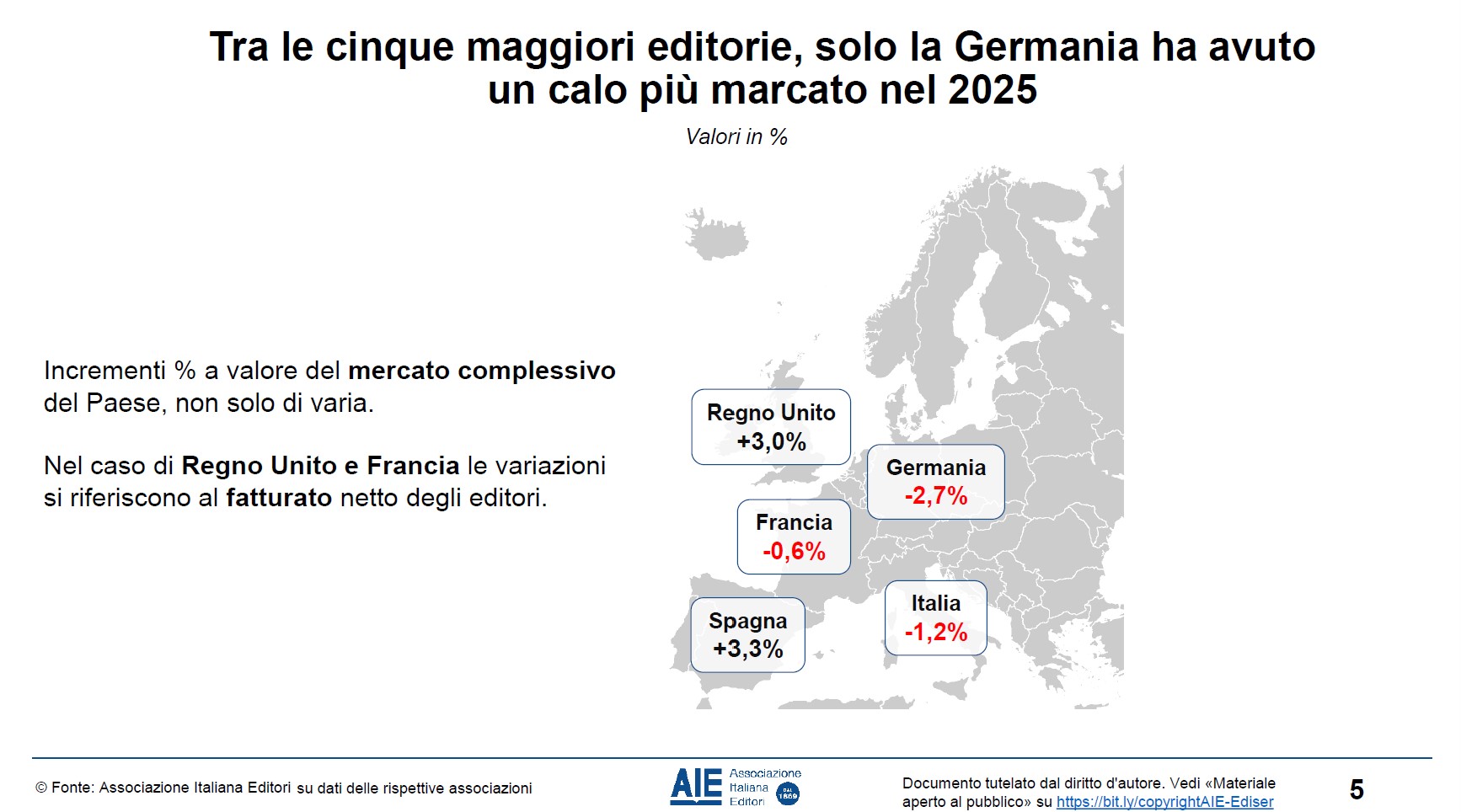
The 2025 for Italian publishing, positive on the internationalization front, nevertheless marked a slowdown on the domestic market, with total sales amounting to 3.198 billion euros, down 1.2% compared to the previous year.
How are book sales performing in 2026?
There is a positive trend for the trade market (print fiction and non-fiction sold in physical bookstores and online and in supermarkets) in the first nine months of the year according to NielsenIQ BookData Panel Market Libri Italia data, with value sales totaling 1,026.5 million euros (up 3.2%), corresponding to 69.8 million copies (up 2.6%). Here, by the way, the top of the best-selling books in Italy in 2026, which features at the top Murdoku – 80 mysterious murders to solve with logic, a bestseller offered by Magazzini Salani, which brings together crime, logic and sudoku.
“A significant role has been played by public demand for books, driven by the 60 million library bonus,” emphasized Cipolletta, noting that thanks to the approach desired by minister Alessandro Giuli, libraries in the South and those located in the most disadvantaged areas were rewarded. “Public demand for books is an essential part of the market and must be safeguarded, also as a tool to reduce inequalities: thus we ask that the bonus be confirmed and stabilized, and that, alongside this, local authorities do their part, not by cutting but by strengthening spending to widen and renew catalogs.”
The share of bookstores continues to grow (online steady, large-scale distribution down)
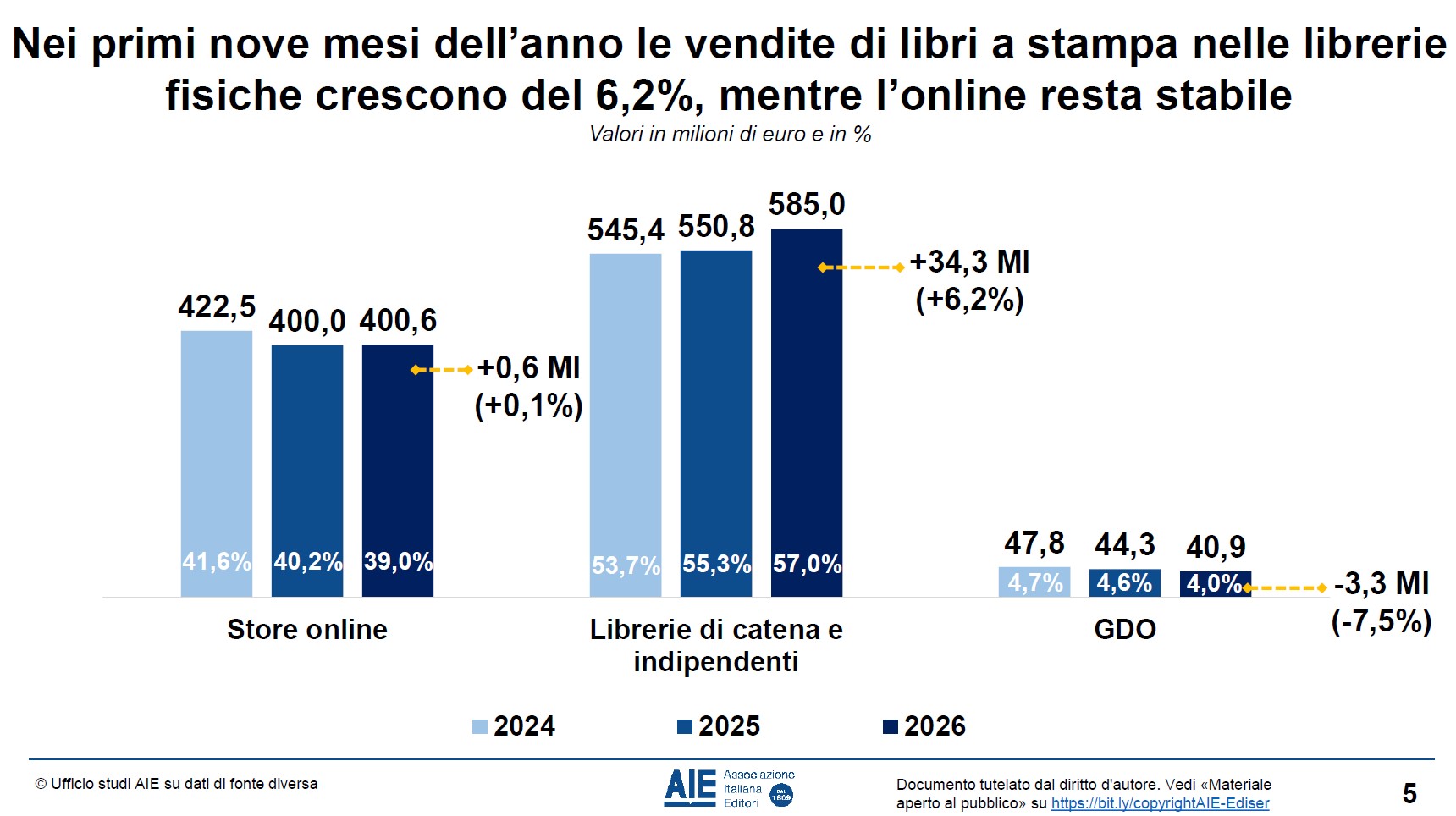
In the first nine months of the year, print book sales in physical bookstores rose by 6.2%, reaching 57% of the entire trade market. Online stores sales are stable (up 0.1%) and their share falls to 39%. The large-scale distribution loses 7.5% of sales and its share drops to 4%.
All narrative genres grow, but “practical manuals and self-help”
There is a mixed trend across genres: a 14.9% surge for comics, a 9.1% rise for children and young readers, 6.9% for foreign-language fiction, and 4.9% for Italian fiction. General non-fiction is in line with the previous year, while specialized non-fiction is in negative territory (minus 1.8%) and practical manuals and self-help are down (minus 6.7%).
The production of books in Italy
In 2025, the titles published for the trade market by publishers were 67,692, the scholastic titles were 3,048. If we add 13,997 self-published titles, we arrive at a total of 84,737 printed titles in a year.
The live catalog from which Italians can choose what books to read remains above 1.5 million (1.53 million). To the numbers of printed-book production published in 2025, we must add 33,284 e-books published during the year.
The publishing world and Artificial Intelligence
In Frankfurt, AI was naturally discussed: three out of four publishing houses (75%) declare they use artificial intelligence tools within their company, according to a survey conducted by AIE among its members at the end of 2025. The use mainly concerns process innovation and back-office activities. 92% of the publishers that employ AI use it in the editorial area; 49% as support for translating internal materials; 44% in commercial, marketing, administrative and managerial activities. More modest, but already significant, is its use for product innovation, indicated by 33%.
In relationships with Big Tech, prudence dominates: 28% of publishers say they have received requests to license their content to a Large Language Model (LLM), but only 4% of these report having already concluded one or more licensing agreements.
Readers are growing in Italy, but…
Readers are increasing in Italy: in 2025 there are 33.7 million people aged 15 to 74 who have read at least one book, even if only partially and not for study or work, in the last twelve months (AIE reading survey), equal to 76% of the population. In 2024 they were 73%. The average weekly reading time, equal to 4 hours and seven minutes, is in line with the previous year, but the frequency of reading is worsening: the share of readers who read at least once a week falls (from 69% to 61%), while the share who read only a few times a month rises (from 17% to 22%) and those who read only a few times a year (from 13% to 16%).
The Italians who report buying 12 or more printed books a year are 9% of the population between 15 and 74 years old; 11% buy between 7 and 11; 17% buy between 4 and 6; 30% between 1 and 3; 33% none. The first group, i.e., the 9% of heavy purchasers, alone generates almost half of the market (43%).