A Much More Human Gesture, That Gives You a Sense of Violence
In 1973, within a bitter and jagged song, Fabrizio De André is astonished by how far one must go to become so “stupid” as to no longer understand that there are no good powers.
Alessia, Milot and Tommaso – the three voices of This unrelenting struggle – on one hand are crushed by powers stronger than them, on the other they discover themselves capable, in turn, of crushing someone else. Each of them is convinced that the power at their disposal is one of the good ones, the kind worth wielding.
Three voices that crush and are crushed
Tommaso, a 30-year-old who lives in a stagnant province, finds himself a victim of the sterile, ruthless offshoring of the company where he works. With the specter of unemployment looming. The suffocating fear of not being able to balance the household budget, with a little girl and a wife who works off the books. And above all, distrust. Distrust in the people and institutions that should help him: a skeletal union, a catatonic State. What to do?
Milot, a contemporary of Tommaso. He was a child when he fled the Kosovo war. Today, he is a young man who no longer belongs either to his homeland, nor to Italy, which continues to see him always and only as an outsider. Meanwhile, inside him, the traumas of what he endured during the war ferment, and the indifference of the institutions and of the people around him acts as a catalyst. What to do?
Finally Alessia, Tommaso’s sister, Milot’s partner. She tries to stay afloat, and to keep them all above water. If Tommaso is overwhelmed by his personal and professional history, if Milot is overwhelmed by History, Alessia is pulled by all these forces. What to do?
In De André’s song, in the end, a revolt erupts: the prisoners seize the prison and, for once, cage the guards.
Both Victim and Perpetrator
And it is precisely this path that the three voices of the novel will take. Tommaso discovers the power of rebellion by finding a way to make himself heard by the factory’s CEO. With the help of Milot, who embraces the power of vengeance, seeing it as a way to rebalance the abuses, the wrongs suffered. And with the help of Alessia, who becomes involved almost by accident, but who will also be drawn to the power of being an accomplice, that is, the power to derail or make Tommaso’s plans succeed.
Each of them is both victim and perpetrator. A victim of their own history and condition, a perpetrator by choice, by frustration, or by a grim hope.
In My Hour of Freedom
In My Hour of Freedom, the De André song playing in the background of this reflection on the characters of This unrelenting struggle, has an open ending.
Let us see the prisoners for once masters of the prison – I picture them on the rooftops, leaping along the walkways – as they chant a song against the crowd that rushes over, curious to see what happened to the prison, what all this uproar is about. The former prisoners stand there, fists in the air, singing their last song: “for as much as you think you are absolved, you are forever implicated.” We do not know what will happen next. Probably a larger power will arrive to quell the revolt, to restore order. It will transform, for half an hour, the prison into a slaughterhouse, and whoever survives will return to their cell.
The story of Tommaso, Milot and Alessia is like that of a body that is thrown to the ground, assailed by four or five tormentors. One of them places a knee on its throat and it writhes, fights, scratches, wounds: will it exhale its last breath before it manages to free itself?
To tell the story of this body three voices were needed, each different from the other. Each with its own tics, its own cracks. Because while it is true that inequality is universal, it is also true that everyone experiences it in their own way.
Paraphrasing Orwell: all people are unequal, but some are more unequal than others.
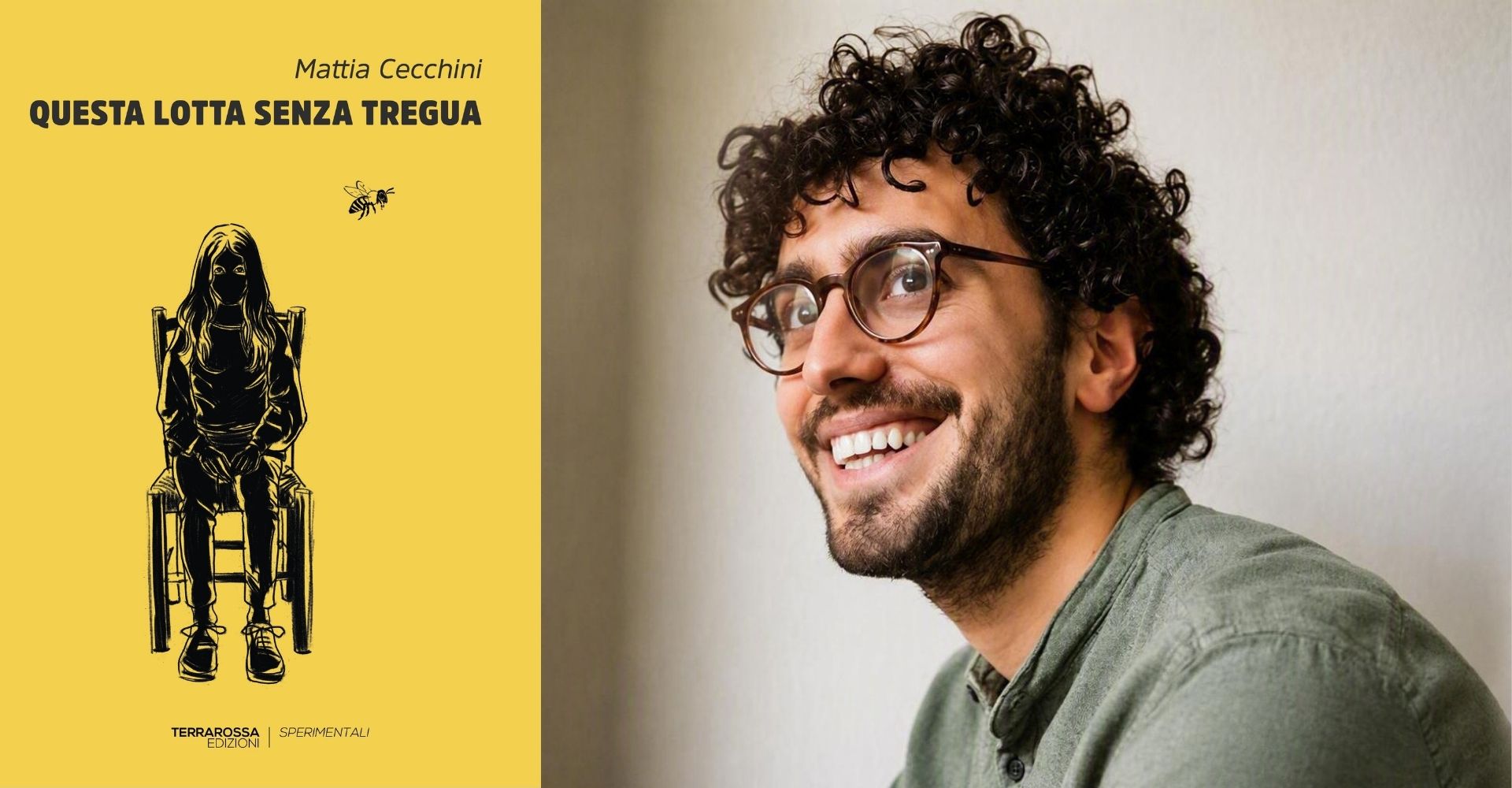
L’AUTORE E IL LIBRO – Mattia Cecchini was born in Umbria in 1992 and works in Nuremberg. Some of his stories have been published in literary magazines and blogs such as ‘tina, Bomarscé, Narrandom, Pastrengo, Split and he has collaborated with Yanez with interviews and reviews. This unrelenting struggle is his debut novel (published by Terrarossa), noted by the Calvino Prize in 2024 and also a finalist for the Zeno Prize and the Dante Arfelli Prize.
The book moves by alternating the viewpoints of three characters, Tommaso, Milot and Alessia, and tells, in a variation of voices and registers, what happens when the feeling of injustice drives us to rebel and asks what the boundaries are between what is lawful to do for a good cause and what is no longer lawful.
The factory where Tommaso works is about to be relocated to Poland: there is a mortgage to pay, preschool for his daughter, and her future… Milot, like him, experiences an insatiable sense of revenge: he has not overcome the wounds of a life lived under gratuitous and cruel violence. Alessia, connected to both, is not blinded by anger but is willing to do anything to help them.