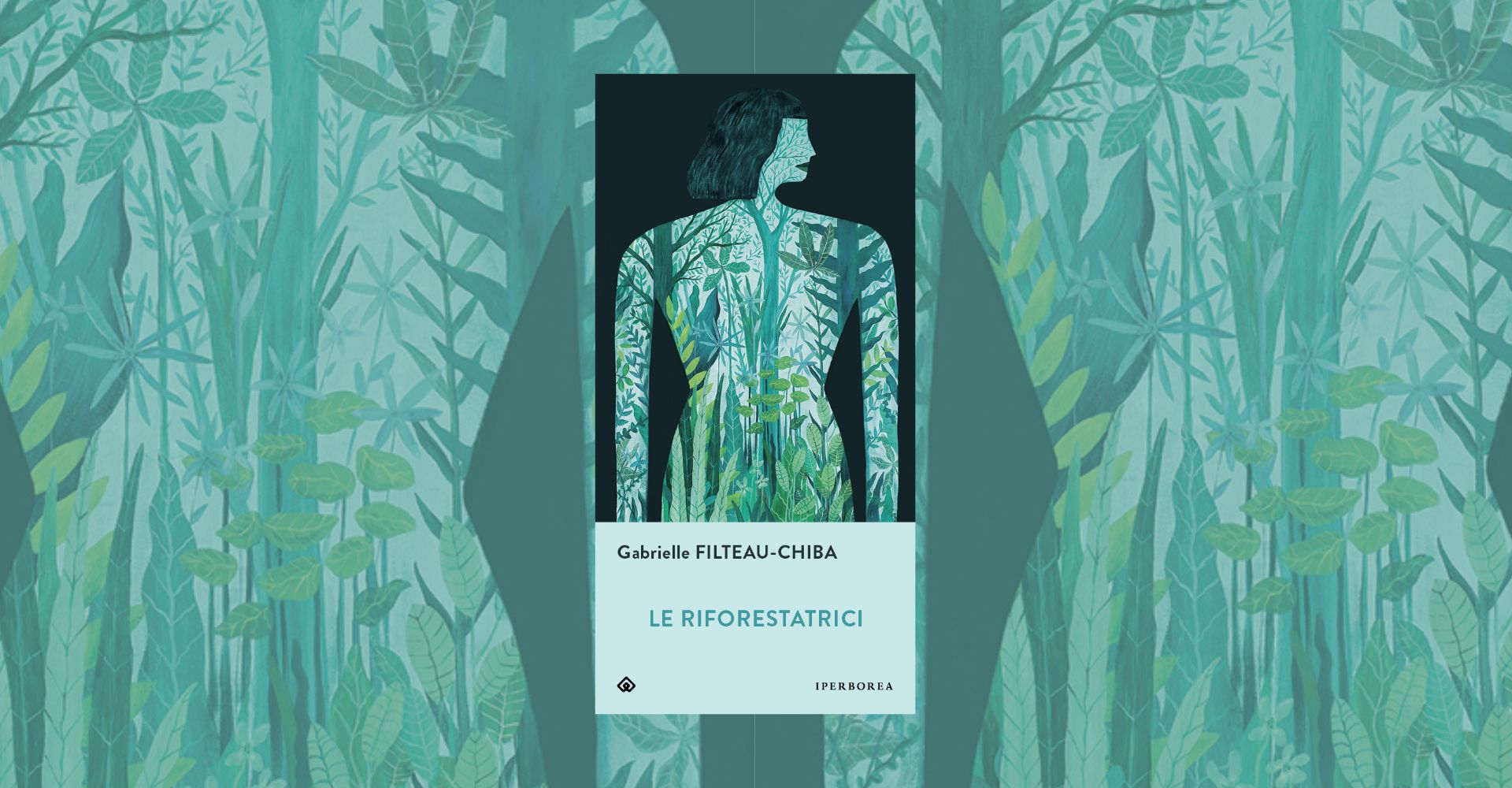
A group of solitary women, beyond the borders of the world (or what remains of it), devote themselves to a race humanity has already lost: saving the ecosystems and the nature of which they are a part.
Sandrine and her companions push on, arms steady as they dig into the earth, clear the roots, plant and begin anew. They keep track of every new tree, shield it from violent storms, making sure their work ensures the survival of those small roots, in the hope that the land scorched by heat will come back to life.
Thalie is fifteen years old, with a purple tuft that covers her face, and she knows little about her mother’s work. She knows that most of the time she’s not there, lost among the North woods, far from the city. But she also understands that that work goes beyond what she can glimpse in the joy in her mother’s eyes, or in the tattoos that multiply on her arms from season to season.

Safety and Control Take Priority
The protagonists of The Reforesters (Iperborea, translated by Luciana Cisbani) are three women (and one man) who watch the world change before their eyes. The society they move in is what remains of a humanity in collapse, which has made security and control the pillars on which to resist.
In the Cité de Sainte-Foy, in Québec, every citizen is watched by technological systems: drones patrol the streets, chips embedded under the skin document lives and behaviors, ensuring compliance with laws designed to preserve the established order.
The dystopia imagined by Filteau-Chiba does not exaggerate in outlining the boundaries of a society rebuilt after what appears to have been a climate catastrophe. Between the lines, however, smolders a political critique that bursts forth in the sisterhood of women who choose to escape from that suffocating world.

Between Self-Exile and Sisterhood
The Reforesters are the natural answer to the domination of control: in a world where the bodies of women are further deprived of their freedom, deciding for them who can generate new life and who cannot, some manage to find an escape, offering themselves for a job that few would take on.
The North, the forest, as it is described in the city, is a place of horrors and threats. Those who inhabit it are outside society, a pariah, a danger to be kept away, confined beyond the walls.
In an overly protected society, which is both cradle and tomb for those who have survived, even a single encounter with a bear cannot help but be experienced as horror, a danger to be avoided at all costs. For Sandrine and the others, however, that danger is life itself: it is the price they choose to pay in order to regain their own freedom.
The novel by Filteau-Chiba is a critique of immobility, of the passive acceptance of authority imposed from above, which page after page tightens the noose around the throat.
The breath of the forest and the scent of the women’s labor clash with the almost surgical candor of the city. The reader is guided into this world through the eyes of Thalie, Sandrine and Gabriel’s daughter, who thanks to an internship has the opportunity to reunite with her mother to collect data on the activities of the reforesters. Thalie faces her own journey with the desire to never disappoint Sandrine: she follows in her mother’s footsteps and, slowly, earns a place in that sect of witches sheltered in the woods, at the margins of society.
Who is Gabrielle Filteau-Chiba
Born in Montréal in 1987, Gabrielle Filteau-Chiba is a writer, translator and editor, as well as one of the most recognizable voices of the new Canadian ecologist fiction. In 2013 she left the city to move alone into a solar-powered cabin on the banks of the Kamouraska river, in Québec.
From that choice arose her Kamouraska trilogy – Encabanée, Sauvagines and Bivouac – translated so far into eight languages and shortlisted for numerous literary prizes between Québec and France (and recently, in the process of a cinematic adaptation). In Italy the public got to know her with the first chapter of the trilogy, released in 2019 by Lindau under the title Nella tana: a diary-novel in which the author, in the role of the protagonist Anouk, recounts a winter of voluntary isolation in the boreal forest, amid the cold, wild animals, and the search for a more authentic existence.

With The Reforesters, Filteau-Chiba leaves the autobiographical register to arrive at dystopia, yet keeping intact the themes closest to her heart: the bond between the female body and nature, the critique of capitalism, and the quest for freedom away from the gears of society.
Witches, Not Only Reforesters
They are witches, after all, the reforesters told by Filteau-Chiba: women devoted to healing, of themselves and of the whole world, who through the trees enact their rite of protection and enchantment. They are sisters dancing around the fire, exhausted, capable of shedding their skin to be reborn from the horrors to which a so-human, so safe, so protected society has forced them.
“These marks on the skin are another form of identity and empowerment,” say those close to us, completely thrilled. “Whatever happens to us, they will clearly declare which side we’re on, to whom we have sworn loyalty. Not to a nation-state, nor to any law. Only to Nature, to the forest.”
“And to our sisters”