di Giacomo Bottà
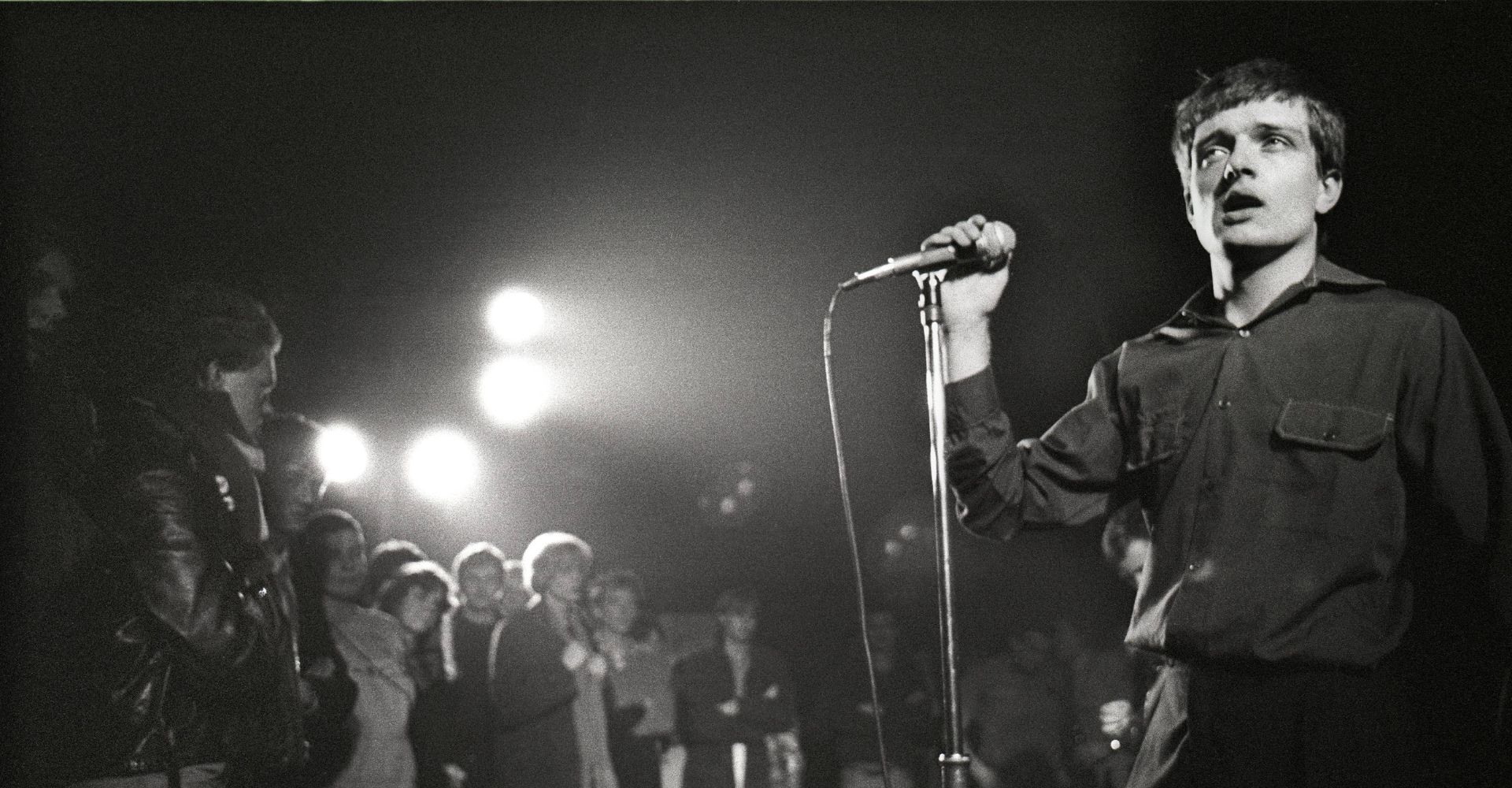
This is the way, step inside. Summer 2025: someone reaches an Alpine refuge in the Dolomites and posts on social media a photo holding a bombolone. May 1980: the ashes of Ian Curtis are scattered by the wind, perhaps in a Macclesfield cemetery in Northwest England.
The story of Ian Curtis I’ve just read in a book. The story of bomboloni, instead, in an online daily. They are two very different stories, but they share something in common: the need to celebrate something—a hike and the death of a singer. Celebrating something helps create a memory and imprint it in a precise place, in these cases, a mountain refuge and a cemetery. The places are possessed by memory and when we visit them, we expect to become participants in it. In the summer of 2026 queues formed for the bomboloni in the high places, and in 2008 the tombstone of Ian Curtis was stolen and never found again.

Eating a bombolone amid the Dolomites can be a pleasant sensory experience and can be captured in photographs that express joie de vivre, exclusivity (there are only 2000 bomboloni per day that can be fried at the refuge) and the sublime, in Kant’s sense. But what does it mean to steal the stone laid in memory of the Joy Division singer, in a small cemetery of a gray and anonymous village in Northwest England?
The Joy Division are an enigma, as noted in a sleeve note on their first EP and as apparent from Disorder – The Story of Joy Division, a substantial volume on the band (or Macclesfield?) written by Fernando Rennis. An enigma that lasts only “the last 1305 days of the seventies and the first five months of 1980,” but which seems to have had a unique significance in the history of popular music.
A Crucial Era in British History
To the general public, it might seem that the group was born at the moment the singer dies, a fate very similar to what will happen with Nirvana. But for Rennis this is of little interest; his aim with this book is to explain chronologically, day by day almost, the birth and evolution of Joy Division, while placing us in touch with a crucial era of British history and in Manchester in particular: that of deindustrialization and crisis.
In a manner very similar to Adam Curtis documentaries, assembled solely from BBC archival fragments, Rennis interlaces the main narrative with snapshots of political, crime, and fashion reportage, which reveal a dark, depressed and violent Great Britain that the Joy Division absorb like a panzerotto soaking up cream.
These fragments help us articulate the band’s story, The Factory, the mad label that released their first album, and Manchester’s lively scene. The city’s musical life seems to drift between pseudo-union solidarity, the emergence of associations, rehearsal spaces and instrument loans, and neoliberal competition among bands to get noticed, land a contract and break through. The Factory sits in the middle: an independent label promoting local acts, not issuing real contracts, yet imagining itself as a business company, oriented toward the hedonistic future of the yuppies.
Joy Division are born and raised in the thick of it. They are all members of the last generation trained for industrial work—the last white-collar workers produced by vocational schools or simply by compulsory schooling—taught to oversee automation, stamp timecards, lick stamps, and file invoices, a stuff of deadly boredom. It is punk and its capillary spread into the provinces that gives their lives meaning and allows them to envision themselves as something else.
The album Disorder, despite its title, has a unique ability to impose order. It speaks of the private lives of the band members and Ian Curtis in particular. It provides detailed chronologies of a myriad of the band’s concerts, drawing on audio materials, articles, reviews, and probably digging through the intricate online fan forums.
Between Disaster and Epiphany
It is interesting to note how Joy Division’s performances continually swing between disaster and epiphany, partly due to the band members’ “northern” temperament—blunt and prone to being overwhelmed by emotion, partly due to Ian’s frail health, grappling with epilepsy, and partly due to the audience, often unprepared to witness something very close to the crucifixion described in the Gospel of John.
Moreover, the author does not shy away from discussing music. The band’s records, demos, and alternate takes of their most iconic tracks are analyzed in a clear and accessible way, foregrounding the vocal and instrumental work of Ian Curtis, Bernard Sumner, Peter Hook, and Stephen Morris, the unique recording techniques of producer and sound engineer Martin Hannett, and the innovative graphics of Peter Saville.
The book also considers the canonization and rediscovery of the band, particularly in Italy, and the academic interest. It reveals that Joy Division were far more than the pulsar image that the Unknown Pleasures cover became, printed on fast-fashion T-shirts or oven mitts, as Half Man Half Biscuit recall in their track Joy Division Oven Gloves.
The oven gloves are, after all, perfect for baking panzerotti.
THE AUTHOR – Raised among the Alps, Giacomo Bottà settled in Helsinki after long spells in Berlin, Strasbourg and Brussels. A university lecturer, researcher and writer, he focuses on music, cities and cultural memory. He is the author of Deindustrialisation and Popular Music: Punk and “Post-Punk” in Manchester, Düsseldorf, Torino and Tampere (Rowman & Littlefield, 2020) and his articles have appeared in various scholarly journals. The English edition of CCCP, Affinities and Divergences (in Italian bookstores with nottetempo) was published in Bloomsbury’s 33 1/3 Europe series.