
In Italy, “students arrive at exams increasingly underprepared.” For seven university professors out of ten (68%), one of the main causes is the progressive loss of the habit of reading and studying university textbooks in their entirety, even though these are considered the most effective teaching tools (88%) and the ones most often indicated as mandatory (50%) and recommended (45%) for exam preparation. Only 17% of professors, in fact, believe that editor-designed teaching tools are today widely read.
From these findings, contained in a survey of 463 first- and second-tier teachers belonging to 34 Italian universities conducted by Talents Venture for the Associazione Italiana Editori, the conference From Fragile Knowledge to Critical Knowledge. University Publishing, Quality and Innovation, promoted by AIE, was launched, which brought together institutions, policy-makers, universities and publishers in Rome to discuss the country’s learning future.
A discussion that placed at the center the value of university publishing as an infrastructure of knowledge and as a safeguard of a critical formation in an era of evolving learning systems, increasingly fragmented.
“A Change in the Ways of Studying”
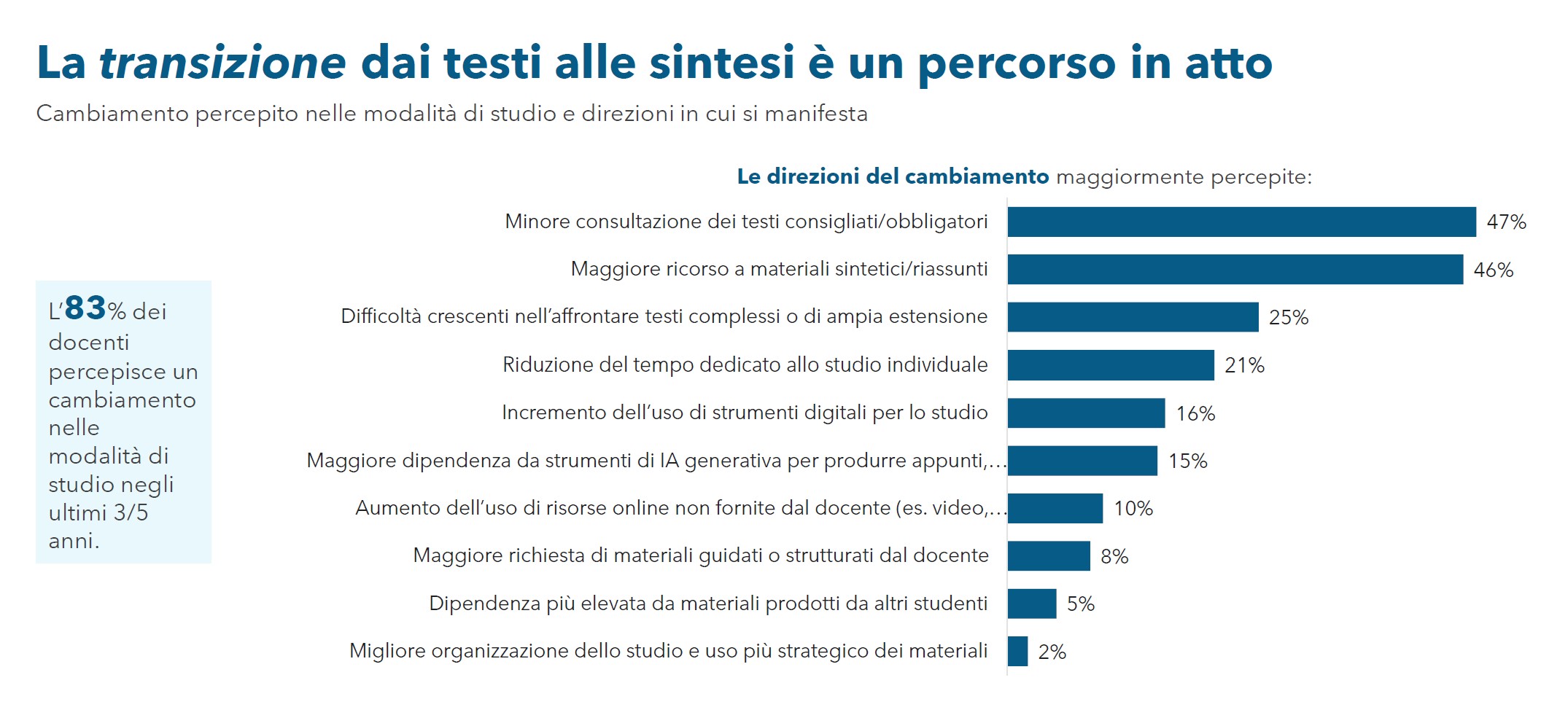
Over the past 3–5 years, in fact, as many as 83% of teachers report a shift in study methods, with a steadily diminishing consultation of texts suggested or indicated as mandatory, a greater reliance on condensed materials and summaries, and growing difficulties in tackling lengthy or complex texts. Course presentations and slides (69%) and notes (52%) are the materials most frequently used, according to the teachers’ opinions.

“Without Books, Critical Thinking and Analytical Capacity Are Diminished”
The result? “Without books, critical thinking and analytical capacity are diminished.” The 68% of teachers involved in the survey identify the lack of habit of reading and studying full study manuals as the cause of the difficulties observed in students’ preparation. Among the most cited deficits are the reduced capacity for analysis and critical reasoning (41%), a superficial, fact-based preparation (28%), difficulty in linking topics together (24%), and poor understanding of basic concepts (19%).
“This – said the president of AIE Innocenzo Cipolletta – is among the sectors historically most open to innovation and change: seven publishers out of ten have brought AI into working processes and into the offering of new teaching tools. At the same time, we are witnessing misuse, passive use of AI tools by some students, to the point that 55% of teachers believe that the impact of algorithms on students’ preparation is negative. The problem, however, is not the technology itself, but how it is used: we must steer this transition by placing editorial content for universities and, more broadly, structured knowledge at the center of training processes.”
“University publishing is the meeting point of research, teaching and business. We create the instruments of knowledge, and for this reason we define ourselves as a privileged observatory of the changes in learning and feel the duty to draw the country’s attention,” emphasized the president of the Academic Professional group Maurizio Messina. “Accessibility or conciseness of information alone are not enough: what we need are authoritative, validated content organized into structured knowledge pathways. This is the value that university publishing brings to education and to the country’s competitiveness. Therefore it is essential to strengthen collaboration among publishers, universities, institutions and the productive sector. The quality of education is a shared responsibility. At the same time, we must address two critical issues: the growing burden of piracy, which has now surpassed the entire market value, and the decreasing use of university texts by students. Ensuring access to teaching materials and supporting the production of authoritative content means investing in the quality of skills and thus in Italy’s future.”
La mattinata di lavori, moderata da Eva Giovannini (giornalista Rai), è stata aperta dai saluti di Federico Mollicone, presidente della Commissione Cultura, Scienza e Istruzione della Camera dei Deputati. Si sono susseguiti, in due diverse tavole rotonde, Massimo Miscusi, Direttore generale per le specializzazioni sanitarie, i dottorati di ricerca e altra formazione post-universitaria del Ministero dell’Università e della Ricerca, la deputata Cristina Rossello (Commissione Politiche dell’Unione Europea), Alfredo D’Attorre, responsabile Dipartimento Università del Partito Democratico e gli editori Andrea Angiolini (direttore editoriale e amministratore delegato de Il Mulino) e Teresa Massara (Sr. Associate Publisher | Global Products di McGraw Hill | Professional Group).
La ricerca di Talents Venture, presentata da Piergiorgio Bianchi, è stata l’avvio della seconda tavola rotonda cui hanno partecipato, oltre al presidente Messina, Riccardo Di Stefano, vicepresidente per l’Education e l’Open Innovation di Confindustria, A Alessandra Petrucci, Rettrice Università di Firenze e Delegata CRUI per la didattica ed Eliana Viviano, direttrice del Servizio Struttura Economica di Banca d’Italia.