Orson Welles, the director of the masterpiece Citizen Kane (1941), in another film, The Third Man (1949), delivers a famous line: “In Italy for thirty years under the Borgias there were wars, terror, murders, massacres, but Michelangelo, Leonardo da Vinci and the Renaissance emerged.” In Switzerland there was nothing but fraternal love, but in five hundred years of peaceful living and democracy, what has become of it? The cuckoo clock.”
The New Book by Cazzullo
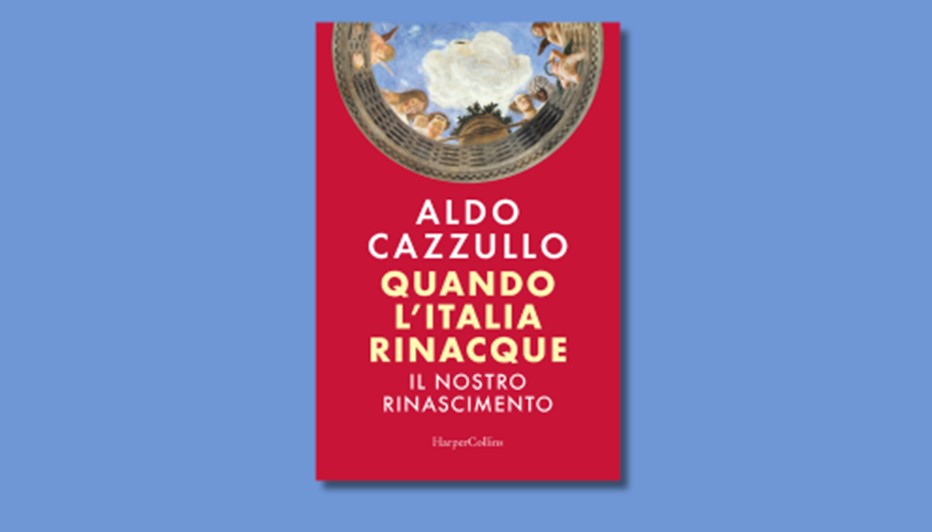
“Perhaps the only wrong detail (apart from the fact that the Borgia pope ruled for only eleven years) is that the cuckoo clock was invented by the Germans.” Thus the ad personam deputy editor and leading figure of the Corriere della Sera, Aldo Cazzullo, in his latest essay When Italy Reborn – Our Renaissance (HarperCollins) adds another precious chapter to the history of Italian identity, addressing the Humanism and its extraordinary protagonists. He defines it as “the true gift we gave to humanity, our great contribution to civilization, without which nothing, not even the current technological revolution, would have been possible.” In fact, he regards it as “a powerful antidote” precisely “to the post-human era that is being prepared.”

Indeed recovering the cultural tradition of ancient Rome and linking it to modern times, the men and women of the Renaissance once and for all forged the idea of Italy and placed man at the center—his dignity, his curiosity. These are the years in which some of the most magnificent masterpieces in the history of art and literature were created: the Cenacolo (The Last Supper), the Gioconda (Mona Lisa), the Scuola di Atene (School of Athens), the Madonna della Seggiola (Madonna of the Chair), the Fornarina, the Pietà, the David, the Giudizio Universale, and later Il Principe, Orlando Furioso, to name just a few.
Non fu un’età dell’oro…
It was not, however, a golden age: it was the age of the Sack of Rome, when modern war was born and our country became a battlefield. And yet culture had a universal breath. It is the era of geographical and scientific discoveries, of opening toward new worlds and horizons of knowledge. “Therefore the first Renaissance man is perhaps Dante, or better the Ulisse of Dante, who refuses to return to Ithaca and sets out beyond the Pillars of Hercules,” writes the author, who returns on September 23 with the new season of Una giornata particolare on La7.
He regards as an anticipator of Humanism the same Saint Francis of Assisi, the protagonist of his previous volume, Francesco – The First Italian (HarperCollins), the best-selling essay in Italy in 2025, which has also become a theatre show with the music and voice of Angelo Branduardi. On the occasion of the 800th anniversary of his death, the Patron Saint of Italy will be celebrated with a stop of the show at the Teatro Carcano in Milan on October 3 and 4.

“Moses was there.” The encounter with the grandeur of Michelangelo shaped his life.
“My imprinting with Renaissance art goes back to when I was six years old and first saw Michelangelo’s Moses. It left such a lasting impression on me that in moments of drowsiness his face appeared to me, with its expressive look and radiant brow: the man who had seen God. From there began my love for Michelangelo, which has never run out.”
A love that binds with the figure of Dante, whom he regards as a precursor of the Renaissance.
“At the end of his journey in the afterlife, Dante obtains the ability to behold the face of God, but words cannot describe it. In that face he recognizes our own image. We are made in the image and likeness of God, and we can glimpse his reflection in the eyes of the person we love. Dante is a precursor of Humanism, for which the human being occupies the center of the world, just as Leonardo’s Vitruvian Man inscribed in the circle embodies, and he possesses an intangible dignity.”
Another concept strongly expressed by Pico della Mirandola in his De hominis dignitate: ‘Tu potrai degenerare nelle cose inferiori, che sono i bruti; tu potrai, secondo il tuo volere, rigenerarti nelle cose superiori, che sono divine’”.
“No individual can be reduced to pure beast or pure angel: the human being represents the wonder of creation, a unique and unrepeatable masterpiece. This value of Humanism constitutes the fundamental contribution that we Italians have offered to universal civilization and is the only powerful antidote against this post-human society that is being shaped, dominated by artificial intelligence, in which man is replaced in the body by robots and in the mind by algorithms. Artificial intelligence can still be placed at the service of humans, as the Pope hopes in his first encyclical, but it is up to us: we are at the crossroads between rising or degrading. As Nietzsche said, ‘Man is a cord stretched between beast and overman’.”
In this sense, Leonardo’s attitude toward his own inventions offers an ethical lesson that AI developers could adopt?
“There is no doubt. Leonardo presented himself to Ludovico il Moro as a military engineer, but chose not to reveal certain inventions so they could not be used in warfare. At one point he states that certain things he does not want and cannot do because ‘they would lead to killings’. The Renaissance is an era of extraordinary technological progress: the clock becomes commonplace (to the extent that Elizabeth I is gifted a wristwatch) and even spectacles. Vittoria Colonna gives Michelangelo a pair when he nearly lost his sight painting the Sistine Chapel. But the real revolution is the printing press.”
She writes: “The great invention of the Renaissance, the one that excites and frightens the most, the formidable weapon in the hands of Galileo and those like him, is not the telescope; it is not even mathematics, science, or the scientific method; it is the book. The book, without which all the rest cannot be known.”
“The Renaissance is a matter of books. The volumes that were once handwritten on parchment and luxurious possessions reserved for a few wealthy people became available in thousands of copies thanks to Gutenberg’s printing, Aldus Manutius, and Erasmus of Rotterdam who wrote the epoch’s longseller. In 1528 the best-selling book after the Bible is The Courtier by Baldassare Castiglione, and in 1532 The Prince by Machiavelli is printed. Engravings were also published, allowing the works of Raphael, Leonardo and Michelangelo to circulate widely.”
Another Renaissance longseller is Orlando Furioso.
“In those years Ferrara received the first world map where the new discoveries find space. It shows Brazil, Florida, a lion indicating Sierra Leone, as well as Asia, Africa and America. It was brought there by Alberto Cantino, who had been commissioned by Ercole I d’Este to travel to Lisbon to procure it. Here the maps of the new lands were guarded at the price of life.”
And Ariosto most probably saw Cantino’s planisphere.
“Yes, and he was captivated by it. Although he detested traveling, so much that even moving within Garfagnana felt terrible, inspired by that map he imagines that his paladins, mounted on winged horses, undertake fantastic journeys analogous to those that the great explorers were actually undertaking. Thus Ruggero, on the Hippogriff, tracks Columbus’ route, Astolfo mirrors Marco Polo, and even goes to the Moon to recover Orlando’s wits.”
Speaking of Columbus, she takes a firm stance against the damnatio memoriae to which he was subjected, calling him a visionary driven by the Renaissance spirit of adventure.
“I have confronted this topic at length, even discussing it with my daughter. For younger generations, Columbus embodies the figure of the first colonizer, bringing dramatic consequences such as slavery and epidemics. Yet his figure transcends a mere historical role: he was the visionary guided by the Renaissance spirit of adventure, the man who opened new horizons for humanity, embodying Dante’s archetype of Ulysses. Ariosto writes: ‘And through the sun’s path, he reveals new lands and a new world’.”
In the book he warns against another insidious phenomenon of the present day: the praise of ignorance.
“Today ignorance often takes on a positive connotation in everyday language, but what worries me most is the complacency of not wanting to know. Columbus, Leonardo, Michelangelo, Raphael, these geniuses who changed history, not only of Italy but of the world, were not people educated in the academic sense: they had no formal studies, they did not know Latin, they had no university education, and at twelve they were already at work painting, sculpting or navigating; and yet they were by no means ignorant people.”
Your parents taught you that the opposite of ignorance is curiosity.
“My grandparents were already working in the fields or in a workshop by the age of twelve, but they were curious people, who kept themselves informed by reading the newspapers and were open to the world. For the greats of the Renaissance the deep impulse is the same: the curiosity to look inside the human body to seize its secrets, to observe the flight of birds to understand it, or, in Columbus’ case, to sail beyond the Pillars of Hercules and push beyond the known boundaries.”
At the center of When Italy Reborn there are extraordinary women to whom he restores dignity, such as Lucrezia Borgia.
“The Renaissance society remained strongly male-dominated and patriarchal, where women suffered under male guardianship, yet many figures managed to emerge with exceptional strength. Lucrezia Borgia, unjustly branded as a poisoner due to a baseless black legend, was in reality a deeply pious woman, a Franciscan tertiary and scarred by great family suffering. Married three times, she loved her second husband Alfonso d’Aragona, but her brother Cesare Borgia had him killed before her eyes. Even her father, who was the Pope, used her as a pawn in his political machinations.”
And then Vittoria Colonna.
“A refined intellectual, muse of the circle of the Spirituali and a precious advisor to Michelangelo, to whom she writes beautiful letters, suggesting what and how to paint. In the same period, her cousin Pompeo Colonna publishes the Apologia mulierum, a revolutionary essay for its time in defense of women’s political capacities.”
Orlando Furioso itself opens with an explicit celebration of women.
“Exactly. Ariosto’s masterpiece opens with the lines ‘Le donne, i cavalier, l’arme, gli amori, le cortesie, le audaci imprese io canto.’ The first character to enter is Angelica, a beautiful woman, princess of Cathay, who makes every knight fall in love—from Orlando onward. And another great protagonist is Bradamante, who will marry Ruggero, becoming the progenitor of the Este family, the lords of Ferrara to whom Orlando Furioso is dedicated, but first she duels with him three times. She is a warrior woman, strong, the woman of the Renaissance.”
In the book she also explores the temperaments of the great masters. Today, in an era that dissects the private lives of artists, how much does character matter? A tormented genius, marked by that “terribilità” she speaks of regarding Michelangelo, how would he be evaluated?
“Comparisons with the past are always difficult: today art has separated beauty and emotion, reduced to a circuit for insiders, a market for collectors, or a mere provocation. One need only think of Cattelan’s banana. But then, who among us truly knows Cattelan, Pistoletto or Mimmo Paladino, given that even among our best-known names the depth may be more limited? In the Renaissance, in Florence, people discussed art on the streets and money turned into beauty, culture and thought.”
How did the deep human diversity among Raphael, Leonardo and Michelangelo translate into their rivalry?
“Raphael was a likeable, charming man, a genius with a winning touch. Michelangelo, by contrast, was intractable. Sansovino wrote that he never spoke well of anyone. Even Leonardo and Michelangelo could not stand each other because they were profoundly different: Leonardo loved company, dressed with elegant silk socks and velvet in pink and purple, while Michelangelo wore always the same dark, crumpled jacket.”
Opposites in public life, but also in intimacy.
“Both were homosexual: while Leonardo lived his orientation with joy, freely loving even very young men, Michelangelo was crushed by guilt. Leonardo loved banquets; Michelangelo ate very little, had no appetite, especially after seeing dissections. And then, even as artists they were at opposite ends: Leonardo hints, Michelangelo shouts; Leonardo evokes, Michelangelo asserts.”
Buonarroti is, moreover, the only one to live a dimension we would today call militant intellectualism.
“It is true. He was a partisan of the Florentine Republic against the Medici: the David is the symbol of the Republic, the boy who fights the giant, and thus the symbol of freedom itself. He also belonged to the circle of the Spirituali, who rejected medieval, dark, superstitious religion, the cult of relics, the sale of indulgences, and the temporal power of the clergy, advocating a return to the authentic faith of the early Christians. They argued that faith and grace save man and sought to reconcile the tenets of Protestantism with Catholicism.”
His militancy, however, did not yield the hoped-for results.
“Michelangelo would be defeated on both fronts: on one side because the Medici regain power in Florence and he is forced to sculpt their statues; on the other because the Spirituali are crushed by the Grand Inquisitor Gian Pietro Carafa, elected Pope Paul IV. The latter wanted to punish Michelangelo: he did not dare remove him from the direction of the Vatican workshops, since the master was planning the dome, but, knowing his attachment to money, he cut his salary, forcing him to work for free.”
About Raphael, she cites Picasso, who believed the Urbinate master gave us the heaven Leonardo had only promised.
“Raphael was a charming genius, the man who brought the Madonna to earth. Raphael’s Madonnas are mothers who embrace the child, make him smile, make him play: each of us can recognize our own mother in them. The problem is that then he dies suddenly at the age of 37, and no one has ever understood why. He dies on Good Friday, just like Jesus.”
Regarding the mystery of his death, recent studies suggest poisoning by toxic pigments such as caeruleum. How does our perception of the artist change if we imagine him a victim of his own quest for perfection?
“It has never been established with certainty what he died of: the latest studies suggest he may have been poisoned by his own colors, but someone in the past even hinted that he was poisoned by a rival. Vasari, for his part, wrote that he died from ‘amorous excesses,’ because he loved women and women loved him. To ascertain it we would have to exhume his body and analyze his bones. But I think Raphael is fine where he lies, in the Pantheon, the temple dedicated to all the gods and thus also to him, a mortal god, beneath that wonderful epitaph that, translated from Latin, reads: Here lies Raphael, from whom Nature, the great mother of things, in life feared to be conquered, and in death feared to die with him. For Raphael painted more truly than true.”
And yet, despite these incredible geniuses and the geographic and scientific discoveries, it is in the Renaissance that modern war is born. For this reason cannot it be called a golden age?
“Italy was a economic and cultural superpower, capable of turning wealth into beauty. Yet it did not become a political power. On the contrary, it became a battlefield among foreign armies that fought over it. And the Sack of Rome in 1527 is emblematic: not only for the massacre, estimated at around 30,000 dead, but because it was a slaughter not seen even during the barbarian invasions.”
Strage that inspired Ermanno Olmi’s beloved film, The Profession of Arms.
“The Landsknechts are descending on Rome to punish the Pope. Clement VII, a Medici, sends his troops led by Giovanni dalle Bande Nere. But the Marquis of Mantua, Federico II Gonzaga, holds the keys to entry into Italy. He must cross the city, where there is the Serraglio, this great fortress made of walls and water with the Mincio, the lakes and the Po. Federico II allows the Landsknechts to pass over the Curtatone bridge, where in 1848 the Risorgimento’s famous battle will be fought, and instead blocks the road in front of Giovanni dalle Bande Nere.”
And here the tragic paradox of that tale unfolds, between internal betrayals and the impact of new warfare technologies.
“Giovanni dalle Bande Nere manages to strike the Landsknechts anyway, but the Duke of Ferrara has given the Germans four falconets—cannons that could pierce even his armor. Giovanni is mortally wounded and dies in a Gonzaga palace: first betrayed, then welcomed. The hypocrisy, the lack of a sense of the State and of the common good that characterizes, unfortunately, our elites and our rulers.”
What is the wish with which he entrusts Renaissance lessons to new generations?
“Humanism is the great contribution of us Italians to universal civilization. I hope that our children and grandchildren will know the Medici story, appreciate Leonardo’s genius, be moved by Raffaello’s early death, evaluate with understanding Cristoforo Colombo’s dream, fly on Ariosto’s fantastic Hippogriff, and be enchanted by Michelangelo’s Moses, as I was. Reflecting on the fact that all these great figures were Italian, like us, who could speak to the world in our language. I hope that our species can study and understand the Renaissance’s lesson, to continue progressing, and not walk the path to self-destruction.”