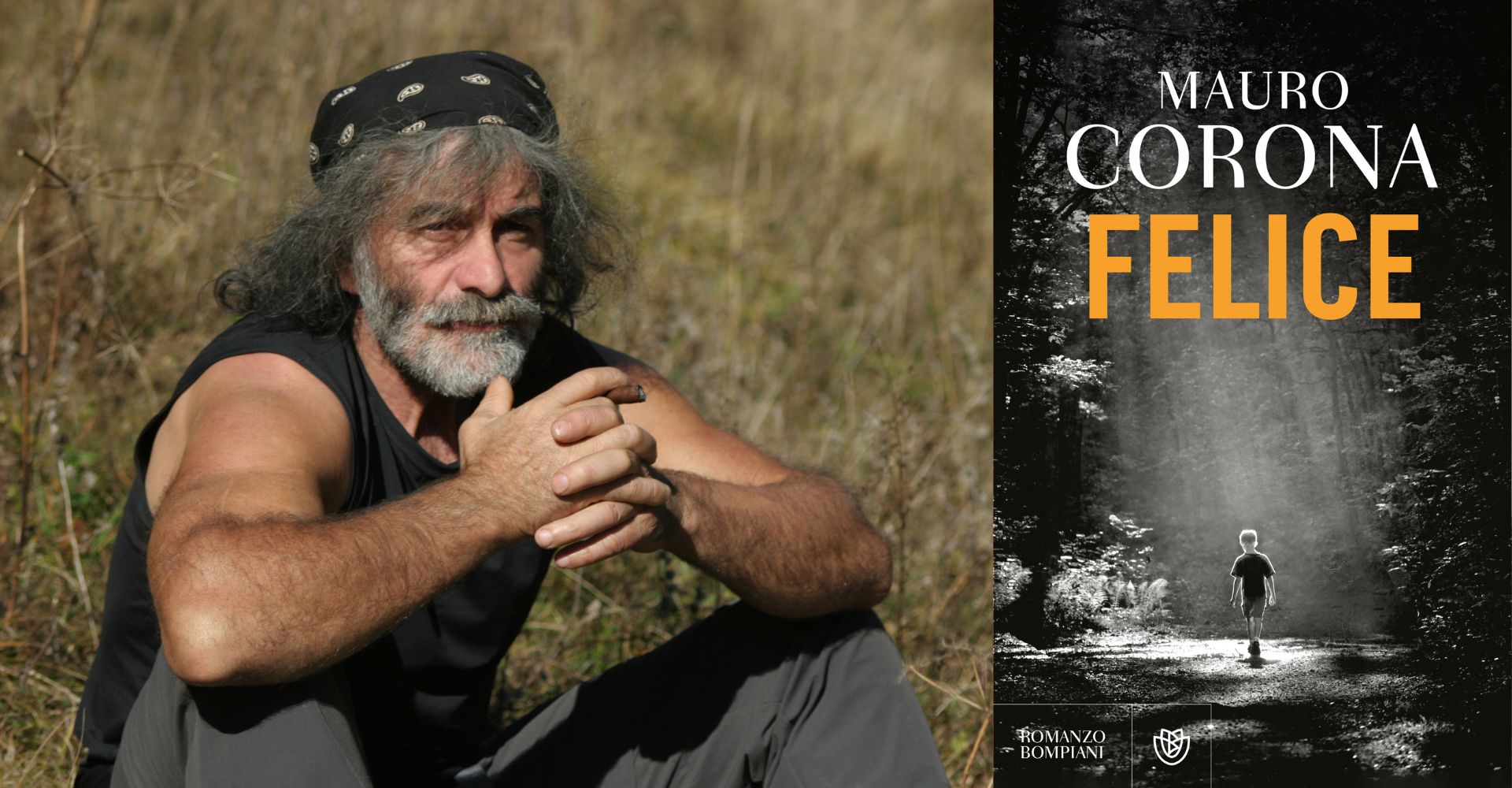
For Mauro Corona a significant milestone arrived in his journey as a writer: he switches publishing houses (from Mondadori, and after the printing troubles of his previous book, to Giunti), in order to tell an intimate and delicate story.
Felice, who gives the title to the new book, was torn from life when he was still a boy, and now his brother Mauro, born in 1950 and father of four, “faces the darkness to find him“.
“The mountain was our open-air pharmacy”
“The mountain was our open-air pharmacy. Whenever we needed care, my brother would take me up there, where there was no closing day and no prescriptions required,” recounts the sculptor, climber, and prolific bestselling author.
Felice and his brothers, Mauro and Richeto, are soon abandoned by their mother, who suddenly left, leaving them at the mercy of a father hardened by alcohol, and watching over them are only the sharp peaks of the Dolomites and a small library of books that would become Mauro’s salvation.
In the new book, a dialogue with his brother Felice
Thus, his childhood unfolds amid a nature that demands quick growth, to measure himself against rock and wind. Felice grows up in a flash, not yet eighteen and already almost two meters tall. Armed only with his youth, he leaves for Germany in search of fortune. He promises his brothers that he will earn money to buy himself a fine suit, and that he will bring Mauro a watch…
It is 1968, the year when youths prepare to change the world. Felice Corona’s adventure, however, ends at the edge of a swimming pool, where he is found dead a few months after his departure.
An afterlife imagined as an immense solitude
Almost sixty years after that day, as night wraps the Vajont valley, Mauro Corona in the new book confronts this absence. Like ancient poets, he “dares to cross the threshold of the realm of the dead” to meet Felice and entrusts him with the task of telling his own story.
Thus, from an afterlife imagined as an immense solitude, in which souls wander in the wind, Felice spares no one. Forced, as the dead are, to tell the truth, he does not spare his brother the harshest and most sincere words, acting as a mirror in a cruel confrontation. Yet, at the same time, he recalls gestures and memories in which anyone who carries in their heart the longing for a broken destiny might find something of themselves…
Mauro Corona’s Books
From his first story, The Breath of the Capercaillie, written more than thirty years ago, to The Paths of Pine Needles (Mondadori, 2025), Mauro Corona has published dozens of books (here is our special feature), including, just to name a few, The Flight of the Marten, The Voices of the Forest, Until the Hoopoe Sings, Drops of Resin, In Wood and in Stone, Rough and Sweet, The Shadow of the Cane, Vajont: Those After, The Ghosts of Stone, Dogs, Chamois, Cuckoos (and a Crow), Snow Story, The Song of the Mánere, The End of the Twisted World (Bancarella Prize 2011), The Ballad of the Ertana Woman, Like a Stone in the Current, Twenty Cheerful Tales and One Sad, A Little Guide to What You Must Drink, The Voice of Cold Men (finalist for the Campiello Prize 2014), A Teal-Colored Teardrop, The Mysteries of the Mountain, A White and Black Fable, The Way of the Sun, In the Wall, The Last Sip, Four Seasons to Live,The Swings and Lunar Romantic.

Many times I have thought about my name. Why, among my brothers, was I the one chosen to carry a name that feels like a mockery of fate? When I think of that scoundrel of a father who hung the name Felice around my neck, I say that name was a noose. A knot that strangled every smile. I was Felice, but I was not happy, not from the start.
He chose the names. He alone. Our mother had no say at all. She told me that one day when I asked her why I had to be Felice only in name. She answered that it depended on fate. To be happy in fact as well was a gift from fate. Some gift it gave me.
Perhaps my father wanted that name for me because it was the same as his father’s, our grandfather’s. He died after being run over by a car at eighty-seven. I died at sixteen in some anonymous city in Germany. The Felices in our family line never had much luck. A cousin of my grandfather’s, Domenico Felice, died on Pal Piccolo during the First World War. He was awarded the Bronze Medal of Military Valour. Another Felice, an ancestor of ours, died crushed by a tree after spending thirty-two years in Austria as a woodcutter. My older brother wrote his biography and changed his name. He could no longer bear to hear it spoken.
My brothers had children. One had four, the other, the youngest, had two. Not for a single moment did they dream of naming one of them Felice. They were afraid he would end in a tragic death like the rest of us.
My grandfather had six children, four of whom died of Spanish flu. They were between nine and fifteen years old. One of them was called Felice. Grandfather often told the story of his unlucky children. He said he had dragged them down from the village to the church on the hay sled. One at a time, because they died one after another. We never saw him cry. When he told the story, he looked far away, as if he were seeing the scene again.
Grandmother, on the other hand, never said anything about that painful affair. We brothers would ask her to explain, hoping to catch, if it was still there, some trace of that distant sorrow. But from her dark brown, scaly face, and from her toothless mouth, nothing ever came. She got out of it by saying: “Dhilà, dhilà, no me pèins pi nìa.” Go on, go on, I don’t remember anything anymore.
Our grandparents were angels without wings. In the end, without light either. As long as they could, they gave us warmth. In the evenings, when we sat beside them around the hearth, I felt a kind of protective energy coming from grandfather’s body. He never gave hugs or caresses; at least, I do not remember any. But a frightened child does not need gestures of the hands or the sounds of words. For the three of us, it was enough to know that the old man thought of hugs and caresses. We knew he thought them. That was enough.
Grandmother, by contrast, was generous with affection. I liked it, and she would stroke my head. My brother, however, did not want to be touched. Not even as an adult. Not even with the women he spent time with would he accept cuddles or caresses. And I know why. Our mother never so much as touched him with a finger when he was little, no kisses, no hugs, no caresses. Never. He suffered a great deal because of that. That is why, once grown, he wanted nothing more to do with tenderness. What he did not receive as a child, he now continues to refuse out of spite. Ice cream, for example, or chocolate, or sweets. When he was a child, though, grandfather used to make him drink wine, and that he still wants. Too much, even.
Watching over this whole unfortunate family group like an angel was the old deaf-mute aunt, grandfather’s sister. Her name was Clementina, known as Tina. She was always praying; you could tell from her lips. When she was young, she could speak and hear. Then some sort of meningitis mutilated her, taking away speech and sound. I know for certain that it was her prayers that protected my brother from the many dangers he ran into, both as a mountaineer and as a drunk.
Every now and then, the wind of the dead brings me their voices. Even my aunt’s, which she found again after death. In death we lose many things, but we discover others we never knew in life. I wish I could hear them more often. They do me good. They remind me of the times when we were together, up there in the village, stuck in a poverty close to misery. From the kingdom of shadows, I now discover that it was the perfect formula for happiness.
Sometimes it is not only their voices that reach me, but also the smell they carried on them like an invisible skin.
Grandfather smelled of wet moss and dead leaves. The tired, mysterious smell of old cupboards when they are opened after years of silence. He chewed tobacco and spat tar, so his smell often changed. It became sharp and sour, so much so that you did not want to go near him.
Grandmother smelled of dead ash and curdled milk. With the addition of smoke when the hornbeam logs had not yet turned to ash. Over everything rose the smell of wild goat.
The deaf-mute aunt smelled of nothing. She was considered a saint, and saints have no smell. The truth is that she took great care of her body, washed often, and perfumed herself with violet and cyclamen petals left to macerate in a litre of alcohol. But, if I really have to remember a smell for her, I would say she had the calm and peaceful scent of patience.
Today, old people no longer have any smell. They smell pleasant, of cosmetics. Many advertise hearing aids and underwear for urinary leaks. Some dye their hair, if they still have any; otherwise they get transplants. They do not want to grow old. They do not notice, or do not want to notice, that by doing this they become ridiculous. The only precaution an old person must scrupulously observe is to avoid making himself ridiculous.
My brother runs no such risks. He washes little, and there is no need for him to perfume himself. He smells of Swiss pine. From carving it so much, that scent of ancient resins has entered beneath his skin. He does not transplant his mane, nor does he dye what remains of it. He would like, I know this, to have his drooping eyelids lifted by a friend who is a cosmetic surgeon. As he is now, he looks like an old wet, sad dog. Leave it alone, brother. You are beautifully ugly. Stay that way.
(continued in bookshops…)